
 X
X WeiBo
WeiBo WeChat
 Facebook
 LinkedIn
 Reddit
 Bluesky
Rotary ultrasonic machining of single-crystal silicon
- Volume
- CitationRaihan K, Obembe I, Wieland D, Jones C, Zhang M. Rotary ultrasonic machining of single-crystal silicon. Adv. Manuf. 2026(3):0011, https://doi.org/10.55092/am20260011.
- DOI10.55092/am20260011
- CopyrightCopyright2026 by the authors. Published by ELSP.
- Special Issue
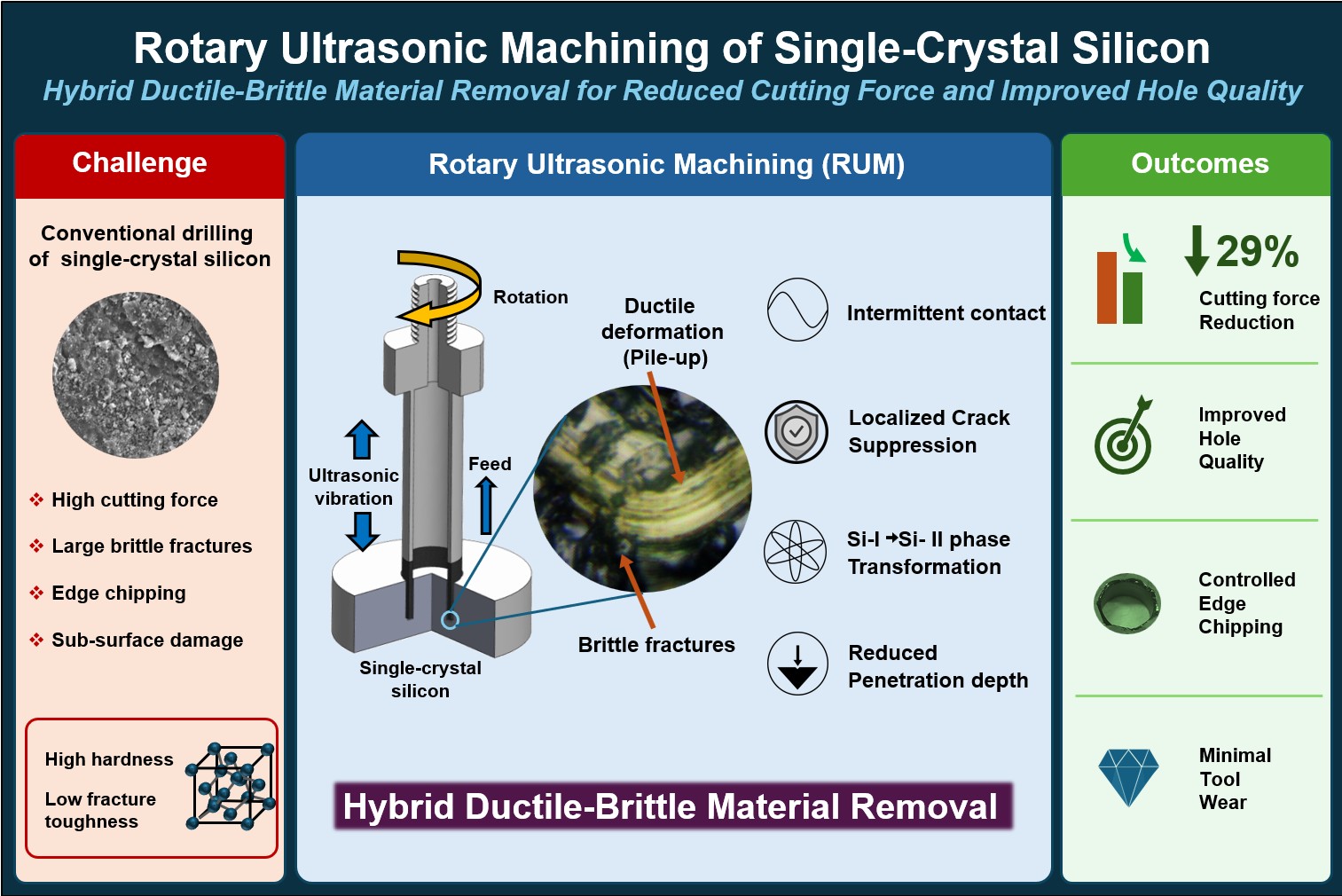
Precision machining of single-crystal silicon components presents critical challenges for the semiconductor and photovoltaic industries due to its high hardness and low fracture toughness. Conventional machining processes are often susceptible to workpiece breakage and subsurface damage, along with high tool wear and poor surface finish. Recent studies have increasingly focused on achieving ductile mode machining of single-crystal silicon using nontraditional machining processes; yet studies on the material removal mechanism remain limited. In this study, the feasibility of rotary ultrasonic machining (RUM) of single-crystal silicon and the material removal mechanism were investigated. The material removal mechanism study via microscopic imaging, motion simulation, and nanoindentation experiments revealed that RUM promoted localized ductile deformation during silicon machining, resulting in a hybrid ductile-brittle material removal mode. The effects of input variables (feedrate, spindle speed, and ultrasonic power) on cutting force, surface roughness, geometrical accuracy of the machined holes, and edge chipping sizes were also evaluated. The results showed that ultrasonic vibration assistance effectively reduced cutting force, while hole quality improvement and edge chipping mitigation were achieved through appropriate selection of machining parameters. Compared with conventional machining conditions, tool wear was also minimal during RUM.
brittle materials; cutting force; material removal; nanoindentation; silicon; surface roughness; ultrasonic machining
