
 X
X WeiBo
WeiBo WeChat
 Facebook
 LinkedIn
 Reddit
 Bluesky
Mechanical properties and failure mechanisms of loess in southern Xinjiang: insights from microstructural evolution
- Volume
- CitationGao X, Xie W, Yuan K, Della Vecchia G. Mechanical properties and failure mechanisms of loess in southern Xinjiang: insights from microstructural evolution. Cont. Life Evol. 2026(2):0010, https://doi.org/10.55092/cle20260010.
- DOI10.55092/cle20260010
- CopyrightCopyright2026 by the authors. Published by ELSP.
- Special Issue
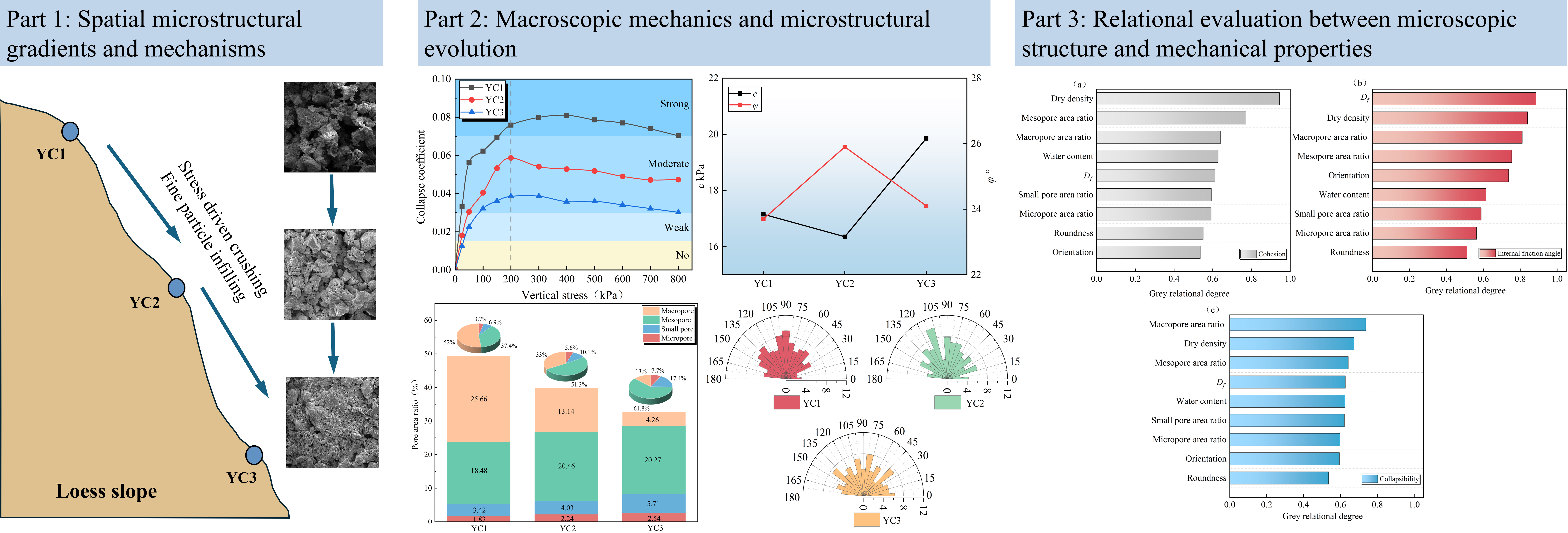
Elucidating the cross-scale coupling between microstructural evolution and mechanical behavior is crucial for understanding the progressive failure of loess slopes in arid regions. Focusing on a typical loess slope in the Yecheng region of southern Xinjiang, this study integrates oedometer-collapse tests, direct shear tests, scanning electron microscopy (SEM), and grey relational analysis (GRA) to quantitatively investigate the spatial heterogeneity of mechanical properties and microstructure. The results show that, from the slope top to the toe, the collapsibility coefficient decreases significantly from 0.076 to 0.039, whereas the shear-strength parameters exhibit nonlinear spatial variations. The internal friction angle initially increases and subsequently decreases, while cohesion shows a slight initial decrease followed by an increase to a peak value. At the microscale, variations in spatial position and overburden stress promote the transformation of an initially loose, point-contact skeleton dominated by macropores into a denser, matrix-supported structure dominated by mesopores and smaller pores. Concurrently, the preferential vertical orientation of the pores progressively weakens, while particle crushing and fine-particle infilling reduce morphological complexity, resulting in a decrease in the pore fractal dimension from 1.73 to 1.61. GRA further demonstrates that different macroscopic mechanical parameters are associated with distinct microstructural variables. Cohesion is strongly related to dry density, mesopore area ratio, macropore area ratio, and water content; the internal friction angle is most strongly associated with the pore fractal dimension; and collapsibility is predominantly related to the macropore area ratio and dry density. These findings establish quantitative links between microstructural evolution and macroscopic mechanical behavior and provide a physical basis for fine-scale landslide hazard assessment and geotechnical engineering design in arid loess regions.
loess; microstructure; collapsibility; shear strength; grey relational analysis
