
 X
X WeiBo
WeiBo WeChat
 Facebook
 LinkedIn
 Reddit
 Bluesky
Research on nonlinear rheology perspective of loess mudflows based on large amplitude oscillatory shear (LAOS)
- Volume
- CitationWang D, Wang X, Wang J, Jia P, Sun D, et al. Research on nonlinear rheology perspective of loess mudflows based on large amplitude oscillatory shear (LAOS). Cont. Life Evol. 2026(2):0012, https://doi.org/10.55092/cle20260012.
- DOI10.55092/cle20260012
- CopyrightCopyright2026 by the authors. Published by ELSP.
- Special Issue
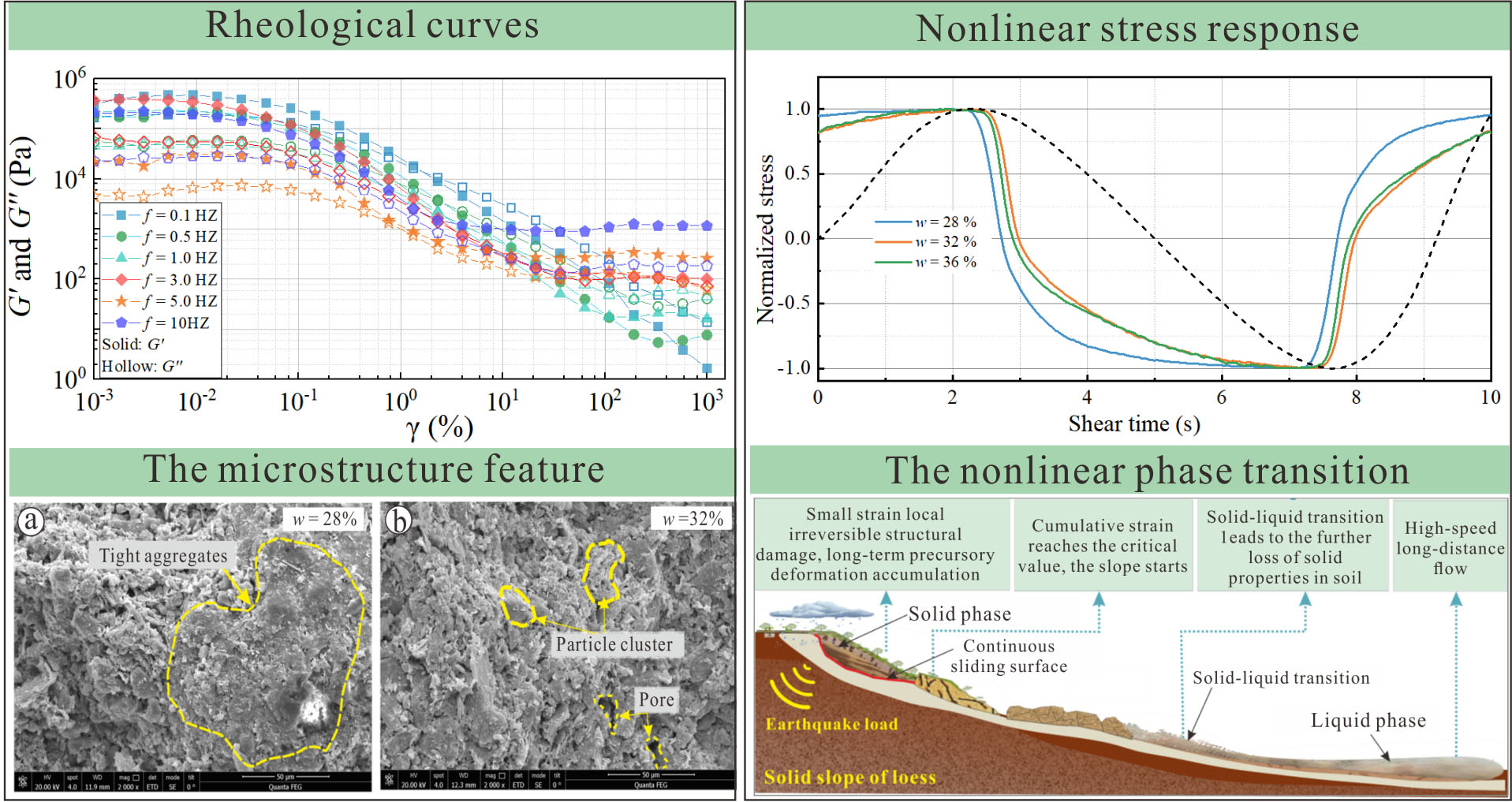
Loess mudflows are typical geological hazards that undergo a dynamic solid-to-liquid transition, yet the yielding process remains poorly constrained. This study investigates the nonlinear rheological behavior of loess slurries with water contents of 28%, 32%, and 36% using large amplitude oscillatory shear (LAOS) and Fourier-transform rheology at frequencies from 0.1 to 10 Hz. Results show that the rheological response evolves from linear behavior to solid-like nonlinearity with a G″ overshoot, and finally to fluid-like behavior. Increasing frequency lowers the linear limit and nonlinear transition strain but raises the nonlinear limit and solid–liquid transition strain. Higher water content can increase the strain required for complete liquefaction; at 36% water content and 5-10 Hz, G′ remains above G″ and no solid–liquid transition occurs. The nonlinear coefficient Q remains nearly constant at small strains and decays with increasing strain and sensitive to strain, water content, and frequency, serving as an early indicator of structural change. SEM observations reveal that higher water content disperses the soil structure and weakens interparticle interactions, explaining the weaker nonlinearity and delayed fluidization. These findings provide a strain-resolved characterization of the solid–liquid transition in loess mudflows and offer theoretical support for hazard assessment and early warning.
loess mudflow; nonlinear rheology; large amplitude oscillatory shear; fourier transform rheology; phase transition dynamics
