
Advanced Information and Communication
ISSN: 3106-1443 (Print)
ISSN: 3106-1451 (Online)
A system-level simulation framework for performance evaluation of ultra-dense wireless networks
Accurate evaluation of radio access performance is essential for the design and optimization of ultra-dense fifth-generation (5G) networks, where the interactions between multiple users, base stations, and interference sources become highly complex. This paper proposes a comprehensive System-Level Simulation (SLS) framework for assessing the performance of multi-user multiple-input multiple-output (MIMO) systems in indoor hotspot environments, following the standardized 3rd generation partnership project (3GPP) InH_B channel model. The proposed framework integrates realistic network-level processes, including user equipment deployment, three-dimensional channel coefficient generation, analog and digital beamforming, link adaptation, and block error rate prediction. Different from conventional SLS studies that often decouple receiver processing, channel state information (CSI) uncertainty, and link abstraction, the proposed framework provides a unified receiver-aware evaluation chain calibrated against 3GPP Phase 2 results. Both Maximal Ratio Combining (MRC) and Interference Rejection Combining (IRC) receivers are implemented to investigate the impact of imperfect CSI on system performance. Extensive simulations demonstrate that the proposed framework provides close agreement with the 3GPP Phase 2 calibration results, while enabling detailed receiver-level comparisons under practical CSI conditions. When CSI errors are considered, the IRC receiver achieves approximately 42% higher average cell throughput and more than 160% improvement in 5% user throughput compared to MRC, confirming its superior robustness to interference and channel estimation errors. The developed framework serves as a practical reference platform for future research on intelligent beamforming, adaptive MIMO receiver design, and machine learning-based link adaptation for beyond-5G and sixth-generation (6G) systems.

Resource management in 6G SAGINs: from optimization-based methods to LLM-enabled agentic decision making
Resource management in sixth-generation (6G) space-air–ground integrated network (SAGINs) is becoming increasingly challenging due to cross-tier heterogeneity, multi-timescale dynamics, and distributed decision making under partial and delayed information. These characteristics expose the limitations of conventional optimization-based and learning-based approaches, whose effectiveness often depends on accurate modeling, large amounts of task-specific data, or opaque policy adaptation. This article revisits the evolution of SAGIN resource management from optimization and learning to reasoning-centric, large language model (LLM)-enabled agentic intelligence. A unified taxonomy of existing paradigms is first presented, clarifying their respective strengths and limitations. The operational foundations of LLM-enabled agents (LEAs) are then introduced, including perception, memory, thought, execution, and tool-grounded decision making, followed by a discussion of emerging multi-agent frameworks for distributed orchestration. Building on this foundation, LEAs are shown to support proactive spectrum control, autonomous cross-tier routing, multi-service scheduling, and dynamic network slicing. Finally, key open challenges are identified, and future directions toward practical, trustworthy, and scalable agentic resource management in 6G SAGINs are outlined.

FBFS: fog backdoor attack based on feature similarity
Most existing backdoor attacks embed triggers in images in ways that are either conspicuous to human observers or easily detected by feature-space defenses, thereby sacrificing stealthiness or robustness. To address these issues, we propose a fog backdoor attack based on feature similarity (FBFS), which enhances the visual concealment of backdoor triggers as well as the feature-space homogeneity between poisoned and clean samples. Specifically, FBFS employs a standard optical model to simulate natural fog as a visually plausible trigger and injects it into image samples. Additionally, a feature similarity penalty term is incorporated into the loss function to enforce consistency in the feature representations of poisoned and clean samples, thereby evading defenses that rely on latent separability. Experiments conducted on Canadian Institute for Advanced Research 10-class dataset (CIFAR-10), German Traffic Sign Recognition Benchmark (GTSRB), and a subset of ImageNet demonstrate that, under a 10% poisoning rate, FBFS achieves over 90% attack success rate while maintaining clean sample accuracy above 85%. Moreover, detection rates under representative feature-space defense methods, including activation clustering and spectral signature analysis, remain below 40%, demonstrating that the proposed method effectively balances attack performance and resistance to detection, exhibiting both stealth and robustness.

A survey on insertion/deletion error detection and correction: progress and future directions
The detection and correction of insertion/deletion (indel) errors have become increasingly critical in domains such as traditional mobile communication systems, the Internet of Things (IoT), smart homes, smart healthcare, vehicular networks, and large-scale urban infrastructure, establishing it as a prominent research focus. As a typical form of synchronization error, the randomness and asymmetry of indel errors severely disrupt symbol alignment and induce significant synchronization drift, thereby imposing substantial challenges on reliable data transmission. This paper systematically reviews methodologies for detecting and correcting indel errors, tracing their evolution from model-driven to data-driven paradigms. First, we summarize the traditional technical framework, which includes synchronization markers, edit distance (ED) codes, sequence alignment, trellis/convolutional structures, and probabilistic models, with an analysis of their theoretical foundations, representative algorithms, and applicable scenarios. Next, we focus on recent advances in deep learning (DL)-based synchronization recovery methods and semantic communication-driven intelligent error correction frameworks, highlighting their distinct advantages over conventional approaches in handling complex channels and unstructured data. Finally, we outline the current research landscape and key challenges in this field and propose future directions for emerging scenarios such as 6th Generation (6G) ultra-reliable communication, satellite links, and ultra-high-density storage. This review aims to provide comprehensive insights and guidance for the design of synchronization and error correction mechanisms in next-generation communication systems.

Optical reconfigurable intelligent surfaces assisted visible light positioning and communications: performance analysis and design optimization
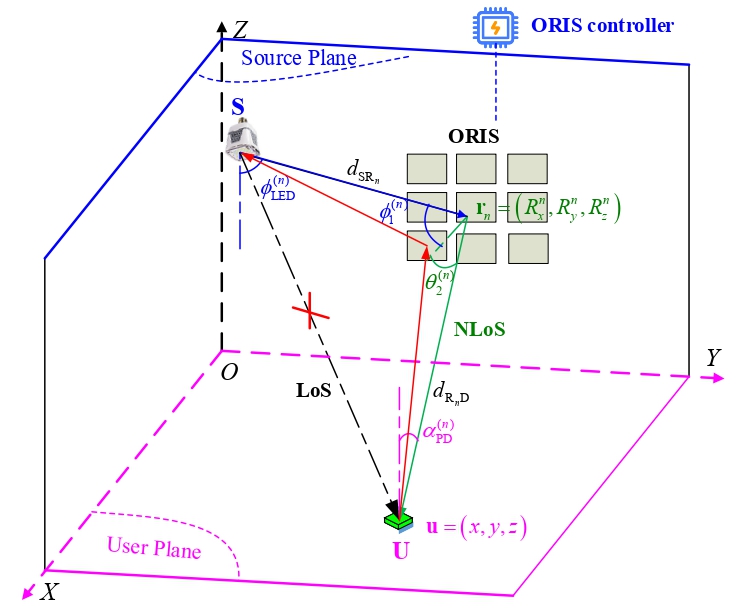
This paper investigates the integration of visible light positioning and communication (VLP&C) facilitated by optical reconfigurable intelligent surfaces (ORIS) to address line-of-sight (LoS) blockage challenges within indoor environments. In contrast to conventional VLP&C systems, which experience significant performance deterioration under LoS blockage, the proposed ORIS-assisted framework dynamically adjusts the reflection patterns to establish reliable non-LoS (NLoS) links. Initially, a comprehensive system model is formulated, encompassing the physical properties of ORIS, including an analysis of time delays and strategies for ORIS deployment. Subsequently, the Cramér-Rao lower bound (CRLB) for positioning accuracy is rigorously derived from the underlying signal models, thereby providing a realistic theoretical performance benchmark. Additionally, closed-form expression for the average mutual information (AMI) and bit error rate (BER) of the communication subsystem are developed, accounting for the finite-alphabet characteristics of on-off keying (OOK) modulation. The study further investigates the trade-offs between positioning accuracy and communication performance across various system parameters, such as the number of ORIS reflection units, half-power angle, and spatial distribution of users. Extensive simulation results demonstrate that the proposed ORIS-assisted system attains centimeter-level positioning accuracy alongside reliable communication performance, even in scenarios where LoS links are blocked. The theoretical findings are validated through Monte Carlo simulations, and the practical implementation challenges are discussed to inform future real-world deployments.
Energy efficiency optimization of STAR-RIS-aided ISAC systems based on user fairness
In this paper, the communication energy efficiency (EE) of simultaneously transmitting and reflecting reconfigurable intelligent surface (STAR-RIS) aided integrated sensing and communications (ISAC) systems underlying a near-field scenario is investigated, where the dual-functional base station (DFBS) serves multiple users and senses multiple targets simultaneously. To ensure user fairness, we formulate an optimization problem that maximizes the minimum (max-min) communication EE while satisfying the minimum target illumination power requirement, the maximum transmission power budget, and the hardware constraints of STAR-RIS under its three operation modes. The formulated max-min optimization problem exhibits non-convexity due to the high coupling among the optimization variables. So as to resolve this issue, the fractional programming is first leveraged to transform the objective function into a more tractable structure. Then, the original max-min problem is transformed into an equivalent maximization problem via introducing the auxiliary variable. Next, we propose an alternating optimization framework to decouple the newly reformulated maximization problem into several sub-problems, which are optimized iteratively until convergence. Finally, the outcomes from the simulations are executed to confirm the advantages and effectiveness of the schemes we have introduced.
