
 X
X WeiBo
WeiBo WeChat
 Facebook
 LinkedIn
 Reddit
 Bluesky
Machine learning based prediction of luminescence properties of ion-doped Cs2ZrCl6 crystalline powders
- Volume
- CitationWang L, Wang S, Wu L, Wang Z, Li Z, et al. Machine learning based prediction of luminescence properties of ion-doped Cs2ZrCl6 crystalline powders. AI Mater. 2026(3):0010, https://doi.org/10.55092/aimat20260010.
- DOI10.55092/aimat20260010
- CopyrightCopyright2026 by the authors. Published by ELSP.
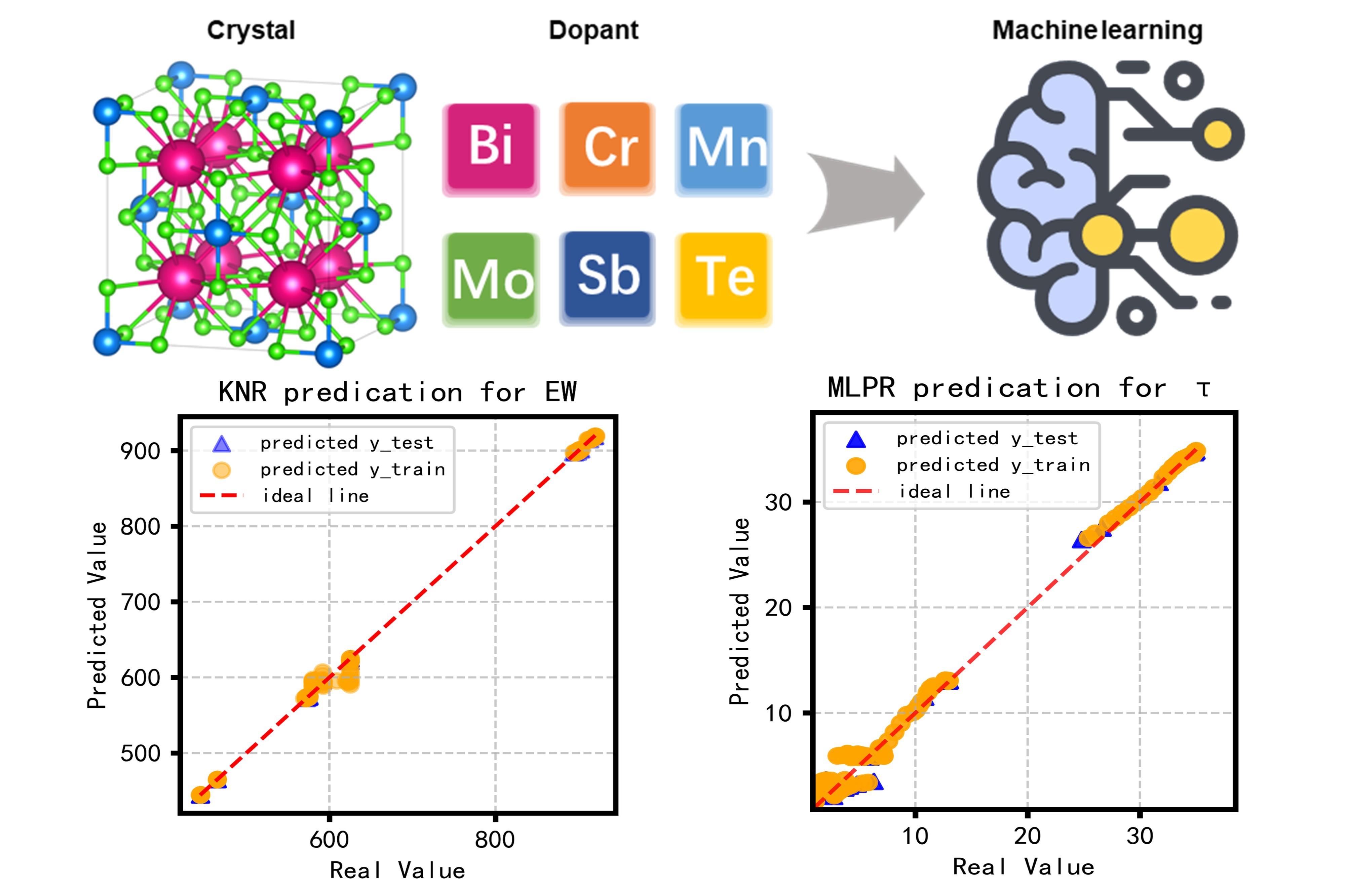
Predicting the luminescence behavior of Cs2ZrCl6 crystalline powders with speed and accuracy is a key prerequisite for designing new scintillators aimed at X-ray imaging. Conventional first-principles calculations based on density functional theory can reproduce crystal luminescence, yet they demand substantial computing power and deep materials-domain knowledge, which together translate into high cost, long development cycles, and limited throughput. To sidestep these bottlenecks, our work adopts a machine learning strategy to predict the luminescence properties of Cs2ZrCl6. A training dataset was assembled from the literature and expanded through linear interpolation. The hyperparameters of six regression algorithms, including ridge regression (RR), K-nearest neighbor regression (KNR), support vector regression (SVR), random forest regression (RFR), XGBoost regression (XGBR), and multilayer perceptron regression (MLPR), were tuned by coupling the covariance matrix adaptation evolution strategy (CMA-ES) with 10-fold cross-validation. Once trained, the models captured a reliable composition-structure-property link. By comprehensively evaluating three metrics of the coefficient of determination (R²), mean absolute error (MAE), and mean squared error (MSE), two optimized luminescence property prediction models were identified. The KNR model was selected for emission wavelength prediction, achieving a high R2 of 0.9999 and a low MSE of 1.4434. Meanwhile, the MLPR model was chosen for decay time prediction, with a high R2 of 0.9893 and a low MSE of 0.9234. Additionally, the Shapley Additive exPlanations (SHAP) analysis further quantified feature contributions to target properties, offering physically reasonable interpretations. This work demonstrates the promising capacity of machine learning for fast, reliable prediction of crystal luminescence performance, providing practical support for accelerating materials-oriented research and development.
machine learning; scintillation crystal; algorithm; luminescent property; prediction model
