
Advanced Equipment
ISSN: 3007-5114 (Print)
ISSN: 3007-5122 (Online)
CODEN: AEABF4
A mechanism-data fusion framework for process-microstructure prediction and optimization in laser directed energy deposition of Ti-6Al-4V using dual-level surrogate modeling
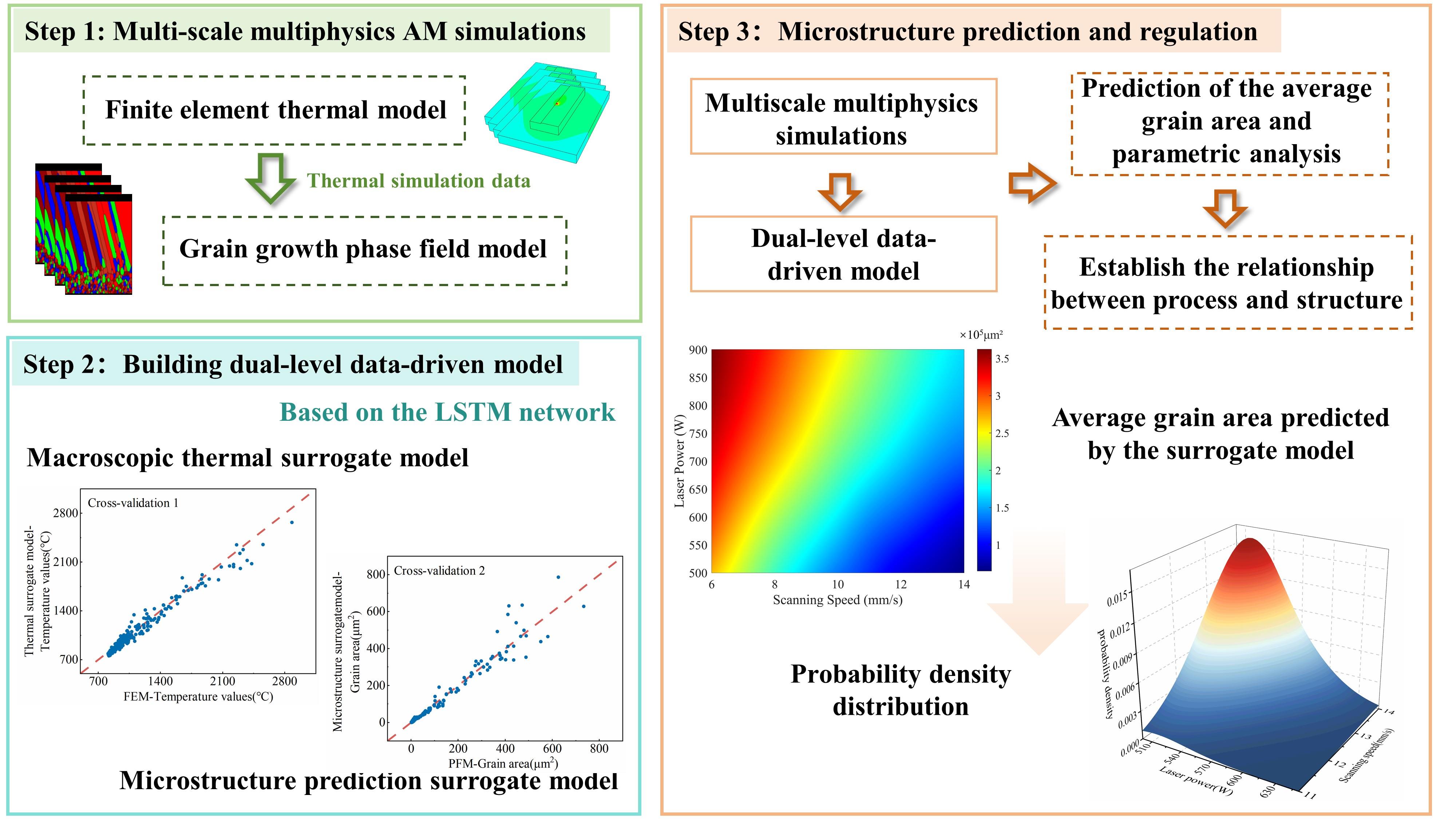
The laser-directed energy deposition (L-DED) process involves complex thermal and material interactions, posing challenges for controlling microstructural evolution in metal additive manufacturing. To enable rapid, efficient process optimization, this study develops a physics-informed mechanism-data fusion framework that couples macroscopic finite element method (FEM) and microscopic phase-field method (PFM) with a dual-level long short-term memory (LSTM) neural network. A multiscale physical model is employed to investigate grain growth behavior and the influence of process parameters on microstructural morphology. To map this non-linear temporal evolution, a dual-level data-driven surrogate model is developed. Compared to a conventional multilayer perceptron (MLP), the LSTM effectively captures time-dependent thermal accumulation. In recursive predictions, four initial input layers were identified as the optimal initialization length, enabling stable prediction and mitigating potential layer-wise error propagation, maintaining average R2 values of around 0.95. Using the average grain area as the primary microstructural control target, and incorporating the average grain width, a parameter range of 500–550 W and 13–14 mm/s was identified for achieving near-equiaxed β grains. The proposed framework is implemented as a modular computational pipeline that integrates finite element, phase-field, and surrogate models for reusable and extensible process-microstructure prediction in metal additive manufacturing.
Adaptive asymptotic tracking control for active suspension systems: an event-triggered approach with input saturation
In this paper, an adaptive neural asymptotic tracking control scheme with the event-triggered mechanism is presented for a quarter-car active suspension system (ASS) with unknown road inputs and input saturation. In the control design, an auxiliary system is constructed to compensate for the input saturation of the actuator, and a linear filter is introduced to solve the chattering problem of the suspension system under the zero dynamics. By integrating integral-bounded functions into the adaptive law and control law, asymptotic convergence of the tracking error is achieved with high precision. Using the adaptive backstepping control method and introducing the command filter, an event-triggered adaptive neural asymptotic tracking control algorithm is developed, in which the radial basis function neural networks (RBFNNs) are used to approximate the unknown model dynamics. Considering the waste of communication resources in the controller, the event-triggered control (ETC) law in the controller-to-actuator channel is designed. Benefiting from the minimal learning parameters (MLP) technique, the proposed scheme requires updating only one parameter, which reduces computational complexity and saves communication resources. By using the Lyapunov’s method and the Barbalat’s lemma, the asymptotic stability of the closed-loop system is proved, and the constraint conditions for vehicle ride comfort are also guaranteed. Finally, the effectiveness of the proposed method is further verified through simulations and experimental results.

Development of a 3D-printed hybrid compliant revolute joint with enhanced directional stiffness
Compliant revolute joints (CRJs) offer advantages in terms of frictionless motion, compactness, and monolithic fabrication, but their practical application is often constrained by an inherent stiffness–flexibility trade-off. High rotational compliance is typically accompanied by insufficient resistance to off-axis deformation, leading to parasitic motion and reduced directional stability. To address this challenge, this study proposes a hybrid CRJ designed to enhance directional stiffness while maintaining large elastic rotational capability. The joint integrates stiff polylactic acid (PLA) reinforcement ribs within a compliant thermoplastic polyurethane (TPU) matrix, with material distribution strategically tailored to suppress off-axis deformation without compromising the intended rotational motion. The design is compatible with monolithic fabrication via dual-material fused deposition modelling (FDM). Finite element analysis, informed by experimentally characterised material and interfacial properties, is employed to evaluate the mechanical performance of the proposed joint. The results demonstrate that the hybrid joint exhibits a significantly higher ratio of off-axis to on-axis rotational stiffness compared with mono-material PLA and TPU joints, indicating effective suppression of parasitic deformation while preserving rotational compliance.