
Asymmetry

ISSN: 3006-2950 (Print)

ISSN: 3006-2969 (Online)

CODEN: ASYMAJ

About This Journal
Special Issues
View more
Advances in Asymmetric Catalysis: From Mechanisms to Applications
Special Issue Editor:   Mario Waser, Shengcai Zheng
Submission Deadline:  10 October 2026
Latest Articles
View more
Advances in asymmetric catalysis: from mechanisms to applications
Kazuaki Ishihara
Editorial24 Jun 2026OPEN ACCESS

I am delighted to see the launch of this Special Issue, “Advances in Asymmetric Catalysis: From Mechanisms to Applications”, edited by Guest Editors Mario Waser and Shengcai Zheng. Having had the opportunity to propose the theme of this Special Issue, I am especially pleased to see it come to fruition. The synthesis of chiral compounds in high optical purity is critically important in medicinal and agrochemical chemistry. K. Barry Sharpless, Ryoji Noyori, and William S. Knowles were awarded the 2001 Nobel Prize in Chemistry for their pioneering contributions to asymmetric oxidation and asymmetric reduction catalysis. These transformations have been primarily achieved using transition-metal catalysts based on elements such as titanium, ruthenium, and rhodium. Subsequently, a wide variety of asymmetric carbon–carbon bond-forming reactions employing chiral Lewis acid and chiral Lewis base catalysts were developed, leading to remarkable advances in asymmetric catalysis.

PDF
Size and/or charge asymmetry effects in coulombic fluids in the presence of external fields: an update
Jonathan Josué Elisea-Espinoza,Cesar Gabriel Galván-Peña,Guillermo Iván Guerrero-García,Enrique Gonzalez-Tovar,Daniel Salgado-Blanco,Fabiola Jaimes-Miranda
Review21 Apr 2026OPEN ACCESS

In a recent review, “Size and/or charge asymmetry effects in coulombic fluids in the presence of external fields: From simple electrolytes to molten salts”, Guerrero-García, Biophysical Chemistry 282, 106747 (2022), one of the present authors analyzed some consequences of breaking the symmetry in the valence and/or ionic size of charged fluids, such as aqueous electrolytes, macroion solutions, or molten salts, when ion correlations and ionic excluded volume effects were taken into account. In this review article, we would like to discuss some additional effects of breaking the symmetry in the valence and/or size of charged particles of coulombic fluids (i) next to a rigid cylindrical charged polymer, and (ii) in the electrostatic properties of an electrical double layer planar supercapacitor. These effects were studied in approaches beyond the classical non-linear Poisson-Boltzmann theory of point ions, by using classical integral equations theory, the Modified Poisson-Boltzmann theory, and Monte Carlo simulations in implicit solvent. As a result, the relevance of the asymmetry in the valence and/or size of charged particles, at microscopic level, is illustrated here either in simple electrolytes or in aqueous colloidal suspensions of macroions, when both are under the influence of an external electric field.

PDF
Functional asymmetries in inside-outside foot mechanics when curvilinear sprinting in baseball
José Antonio Martinez-Rodriguez,Jonathon Neville,John Cronin
Article01 Apr 2026OPEN ACCESS

The purpose of this study was to determine whether inside-outside foot asymmetries were observed when running multiple bases in baseball. Fifty-four trained male high school baseball position players performed two linear 54.7-meter sprints and two home-to-second base sprints. Ground contact time (GCT), stride length (SL), and average push-off and impact were quantified using inertial measurement unit foot pod technology. The sprints were divided into four segments (0–13.7 m; 13.7–27.4 m; 27.4–41.1 m; 41.1–54.7 m) for both curvilinear segments (C):C1–C4, and linear segments (L):L1–L4. The primary findings of this study were that for linear sprinting, GCT was not significantly different between feet across all segments, but SL was significantly shorter (L2–L4) in the outside foot (−0.76% to −1.34%; ES = −0.20 to −0.37) and push-off were significantly greater (L1–L4) in the outside foot (2.95% to 4.39%; ES = 0.27 to 0.40), with significantly greater outside-foot impact only in L1 (5.63%; ES = 0.29). In curvilinear sprinting, the inside foot was found to have significantly longer GCT in Segments 2–4 (−3.13% to −7.79%; ES = −0.38 to −1.29), higher push-off (3.83% to 4.39%; ES = 0.31 to 0.41), and segment-specific SL changes. Inside–outside foot asymmetries are driven by the linear-curvilinear demands of specific segments, peaking in Segment 3 where stabilization demands are greatest. These findings highlight the need for segment-specific training that develops inside-foot stability and outside-foot propulsion to optimize base-running performance in base runners.

PDF
Top Downloaded
View more
Asymmetry of cross kinetic coefficients in the cell model of a charged membrane
Anatoly Filippov
Article11 Apr 2025OPEN ACCESS
Theoretical study was performed earlier for the cell model of a charged porous membrane based on Onsager’s approach and the result was calculation of all electrokinetic coefficients. Experimental dependences of electroosmotic permeability, conductivity, and diffusion permeability of some perfluorinated membranes on electrolyte concentration were simultaneously and quantitatively described using exact analytical formulae based on the same set of physicochemical and geometrical parameters. It is shown here that for the developed cell model of the ion–exchange membrane, the Onsager principle of reciprocity is violated—the coupled cross kinetic coefficients are not equal. The violation is associated with the fact that the reciprocity principle takes place only for systems for which generalized fluxes are zero at thermodynamic forces other than zero within the framework of linear thermodynamics of irreversible processes.
PDF
On uneven ground: embracing the challenges of inter-limb asymmetries and their assessment
José Afonso,Adam Virgile,Javier Peña,Matthew Jordan,Antonio García-de-Alcaraz,Mário Sá,Chris Bishop
Article20 May 2025OPEN ACCESS
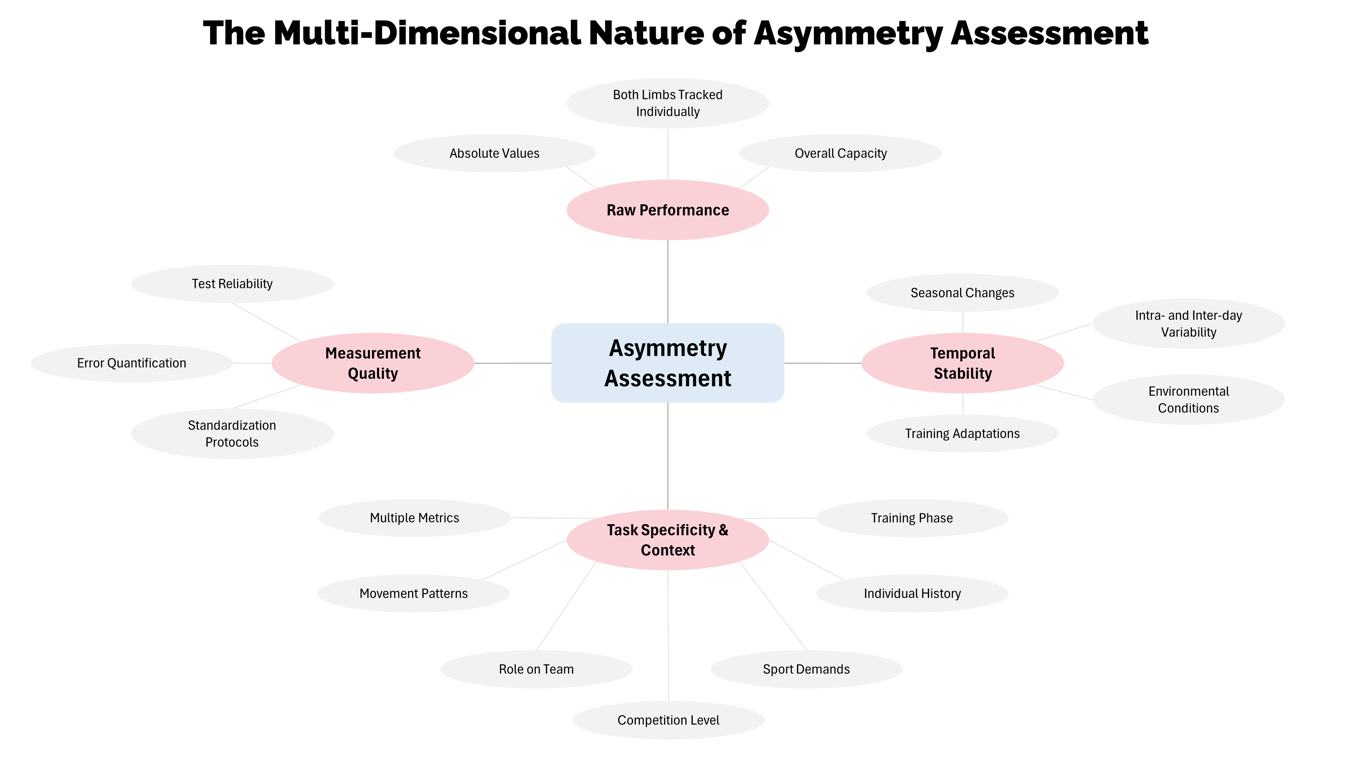
Inter-limb asymmetry is often misunderstood in sports and healthcare, with natural differences seen as problems usually needing correction. Evidence linking inter-limb asymmetries to increased injury risk or reduced performance is weak, and asymmetries of 5–15% (or even higher) typically do not increase the likelihood of injury. Assessing inter-limb asymmetries is a complex matter. Practitioners should select tests aligned with sports demands and track changes over time, rather than relying on single time point data. Ongoing temporal assessments help distinguish meaningful trends from natural fluctuations. Measurement error should also be considered to ensure changes exceed the minimal detectable change and reflect genuine performance or shifts in injury risk. Intra-individual analysis is recommended over averages across groups, as they can obscure meaningful variations. Arbitrary thresholds for what may be considered “normal” asymmetries oversimplify a continuous variable, potentially leading to misleading conclusions. Focusing on ranges (e.g., confidence intervals) instead of point values (e.g., mean) provides a more nuanced view. In addition, interpreting raw limb data alongside asymmetry metrics is crucial, as similar asymmetry percentages may arise from different limb strength profiles. Tracking raw data ensures that interventions improve performance, even if asymmetries persist. We provide a framework to help guide practitioners’ decisions. Task specificity and context, temporal stability, measurement quality, and raw performance data are key pieces of the puzzle. Before implementing “asymmetry-correcting” programs, practitioners should answer key questions, for which we provide a user-friendly decision tree. Not all asymmetries are likely to yield meaningful benefits if corrected, and intervening in asymmetry should result from a carefully reasoned process that requires establishing relevance, ensuring measurement quality, gathering appropriate data, and considering practical implications.
PDF
A new mathematical strategy for creating asymmetric continuous distributions
Christophe Chesneau
Article19 Sep 2024OPEN ACCESS
In this article, we present a new mathematical strategy for creating flexible asymmetric continuous distributions. It is designed to introduce asymmetry into any distribution with the entire real line as support, thanks to the tuning of two parameters and an intermediate function. A wide range of intermediate functions of different types can be chosen, including a high degree of adaptability. To illustrate this strategy, we present four types of asymmetric normal distributions and four types of asymmetric Cauchy distributions. Some of them have rare properties, such as multimodality (bimodality, trimodality, and more) and abrupt angular shape for the corresponding probability density functions. These features are supported by an extensive graphical analysis. Finally, we discuss the adaptation of the strategy for distributions with different support.
PDF