Electronics and Signal Processing
ISSN: 2959-913X (Print)
ISSN: 2959-9148 (Online)
CODEN: ESPLA8
Performance evaluation of chaos-based FM waveforms with optimized ambiguity functions against FMCW and noise radars in LPI applications
Modern electronic-support measures (ESM) increasingly employ deep-learning classifiers that exploit the deterministic, periodic structure of conventional low-probability-of-intercept (LPI) waveforms such as linear frequency-modulated continuous-wave (FMCW) signals. This paper investigates chaos-based frequency-modulated (CBFM) waveforms, generated from the Lorenz and Rössler attractors, as a countermeasure. Using a fully simulation-based framework (2 GHz sampling rate, 10 µs pulse, 500 MHz bandwidth, time–bandwidth product 5000), we compare CBFM against calibrated FMCW and band-limited noise-radar references on spectral flatness, autocorrelation peak-sidelobe ratio (PSR), ambiguity-function shape, and a newly defined inter-pulse correlation gain (IPCG) that quantifies an interceptor’s ability to reuse a previously captured pulse. Although FMCW attains the flattest spectrum (spectral flatness measure 0.97) and lowest sidelobes (PSR = −21.4 dB), it is perfectly periodic (IPCG = 1.0) and therefore fully exploitable by a replica-based interceptor. Lorenz-CBFM reduces the IPCG to 0.072, essentially the noise-radar floor (0.063), while delivering a thumbtack ambiguity function free of FMCW’s range–Doppler coupling, at the cost of modestly higher sidelobes (−17.8 dB). A derivation linking IPCG to interceptor coherent gain shows that a replica-reuse interceptor detects an FMCW emitter from about 14 times farther away than a Lorenz-CBFM emitter. A convolutional-neural-network experiment confirms that all four families are recognizable by type, yet a learned next-pulse predictor recovers near-unity coherent gain only for FMCW. Detection is modulation-independent at equal pulse energy, while the thumbtack waveforms remove a systematic range–Doppler bias that displaces a 1500 m/s FMCW target by a full range-resolution cell. A 13-point parameter study identifies the Lorenz parameter ranges maximizing spectral flatness and minimizing sidelobe levels.

Structured-light modes for optical communications and computing: opportunities and challenges
Structured-light modes have emerged as a promising information carrier for both optical communications and optical computing because they provide high-dimensional spatial degrees of freedom (DOFs) for multiplexing and modal transformation. Although numerous demonstrations have reported increasing transmission capacities and computational functionalities, their practical significance is often evaluated by nominal modal dimensionality rather than system-level usability. In this commentary, we argue that structured-light communications and computing share a common framework of modal transformation and should therefore be assessed using unified system-level criteria. We compare representative structured-light mode groups, discuss their roles in communications and computing, and highlight the practical challenges associated with modal fidelity, modal crosstalk, and scalability. We further propose that the key figure of merit for future structured-light systems should be the usable modal dimensionality achievable under realistic operating conditions, providing a practical perspective for the development of scalable photonic information processing.

Analysis of dementia EEG signals using empirical mode decomposition variants and deep learning
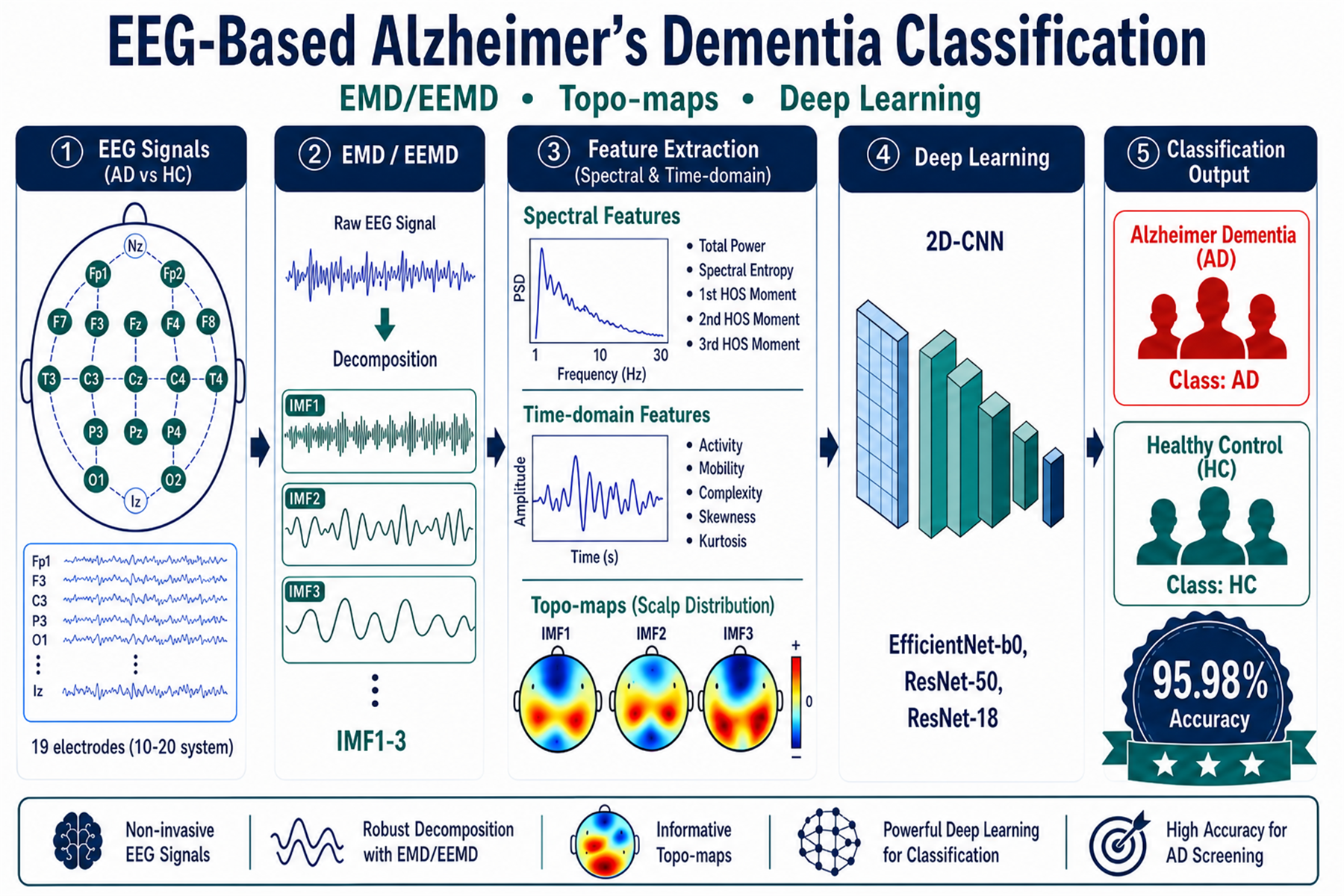
In recent years, Alzheimer’s dementia (AD) is the most common neurological condition caused by electrical activity changes in the human brain. The diagnosis of AD can be provided by using medical devices such as electroencephalography (EEG). In this study, EEG signals of AD patients and healthy control subjects were analyzed. Advanced signal decomposition methods, which are empirical mode decomposition (EMD) and ensemble empirical mode decomposition (EEMD), were used to further investigate EEG signals. The first three intrinsic mode functions (IMFs) were obtained using the EMD and EEMD methods. Spectral and time-domain features were extracted from IMFs and raw EEG signals. Then, topographical heat maps were generated from these features. Topographic Feature Map (Topo-map) were classified using a two-dimensional convolutional neural network (2D-CNN). Different CNN architectures were compared in terms of performance, including EfficientNet-b0, Resnet-50, and Resnet-18. The experimental results demonstrate that the proposed approach effectively captures the spatial and spectral characteristics of EEG signals associated with Alzheimer’s disease. 95.98% classification accuracy was achieved with the EfficienNet-b0 architecture.
A study of SerDes logic for visible light communication using 8B13B code
Visible light communication (VLC) has been increasingly implemented in data transmission to overcome the limitations faced by radio wave communication. However, obtaining specialized equipment, particularly serializers and deserializers, remains a significant challenge for the realization of the VLC systems. In this study, we developed an 8B13B coding scheme for VLC that enables reliable synchronization and effectively addresses pulse-width variations. The proposed serializer and deserializer (SerDes) logic was implemented in Verilog hardware description language (Verilog HDL) and deployed on a field-programmable gate array (FPGA), which interfaces with Raspberry Pi via the serial peripheral interface (SPI), forming a simple yet effective communication system. Although the overall communication speed relies on the data transfer frequency between the FPGA and Raspberry Pi, the bit rate was 3.48 Mbit/sec. We evaluated the communication quality of the system in environments with ambient light interference and achieved stable communication over a distance of approximately 3 m between the light emitting diode (LED) light source and receiver. The ability to use the VLC with the widely popular and commonly used Raspberry Pi is expected to promote the advancement of research and development of applications utilizing this communication system.