

International Journal of Environmental Epidemiology
ISSN: 3079-2746 (Print)
ISSN: 3079-2754 (Online)
Developmental time as a design principle for maternal and child exposomics
Maternal and child exposomics can characterize complex exposure profiles, but measurement remains uneven across the developmental continuum. Although prospective preconception cohorts and studies of minipuberty demonstrate the feasibility of early enrollment and infant hormone phenotyping, these windows are not routinely harmonized across cohort designs. We propose developmental-event-guided exposomics, combining core pregnancy and birth assessments with targeted preconception recruitment and infant sampling during biologically defined windows. Sampling frequency and specimen type should reflect chemical toxicokinetics, with paired external and internal measurements used to calibrate exposure estimates. Computational models should quantify uncertainty rather than obscure unobserved developmental states. Standardizing a limited set of sentinel windows could reveal modifiable sources while biological responses remain measurable, providing a stronger basis for timely exposure reduction before critical opportunities for prevention are lost.
Reducing PM2.5 exposure and lower hypertension risk: evidence from two large cohort studies
Objective: Although the adoption of air pollution mitigation strategies has greatly improved air quality over recent decades, their beneficial effects on health remain underexplored. We therefore investigated the association between reductions in PM2.5 exposure and hypertension risk. Methods: This prospective cohort study utilized data from the Taiwan MJ Cohort (2005–2016) and the UK Biobank (UKB, 2006–2015), representing medium- and low-PM2.5 areas, respectively. Ground-level PM2.5 data were derived from the Atmospheric Composition Analysis Group and matched to each participant’s residential address. Participants whose baseline exposure exceeded the cohort-specific median PM2.5 level were included (MJ Cohort: n = 38,397; UKB: n = 66,837). Covariates and outcome definitions were standardized across cohorts, and Cox regression models with inverse probability weighting (IPW) were used to analyze the associations between PM2.5 reduction and the 5-year risk of hypertension. A parallel analysis was performed among individuals with pre-hypertension. Results: In the MJ Cohort, participants who experienced a reduction in PM2.5 exposure had a significantly lower risk of developing hypertension compared with those who continuously lived in high-PM2.5 areas (hazard ratio [HR] = 0.83, 95% confidence interval [CI]: 0.73–0.95). Each 1 µg/m³ decrease in PM2.5 exposure was also associated with a reduced risk of hypertension (HR = 0.97, 95% CI: 0.95–0.99). In the UKB, a significant association was observed only when PM2.5 exposure was analyzed as a continuous variable (per 1 µg/m³ decrease: HR = 0.85; 95% CI: 0.76–0.94). Notably, the benefits of reduced PM2.5 exposure were even more pronounced among individuals with pre-hypertension in both cohorts. Conclusion: Analysis of two large cohorts from regions with varying air pollution levels demonstrates that reductions in long-term PM2.5 exposure are consistently associated with a lower risk of developing hypertension, providing direct evidence of the substantial health benefits of improved ambient PM2.5 levels.

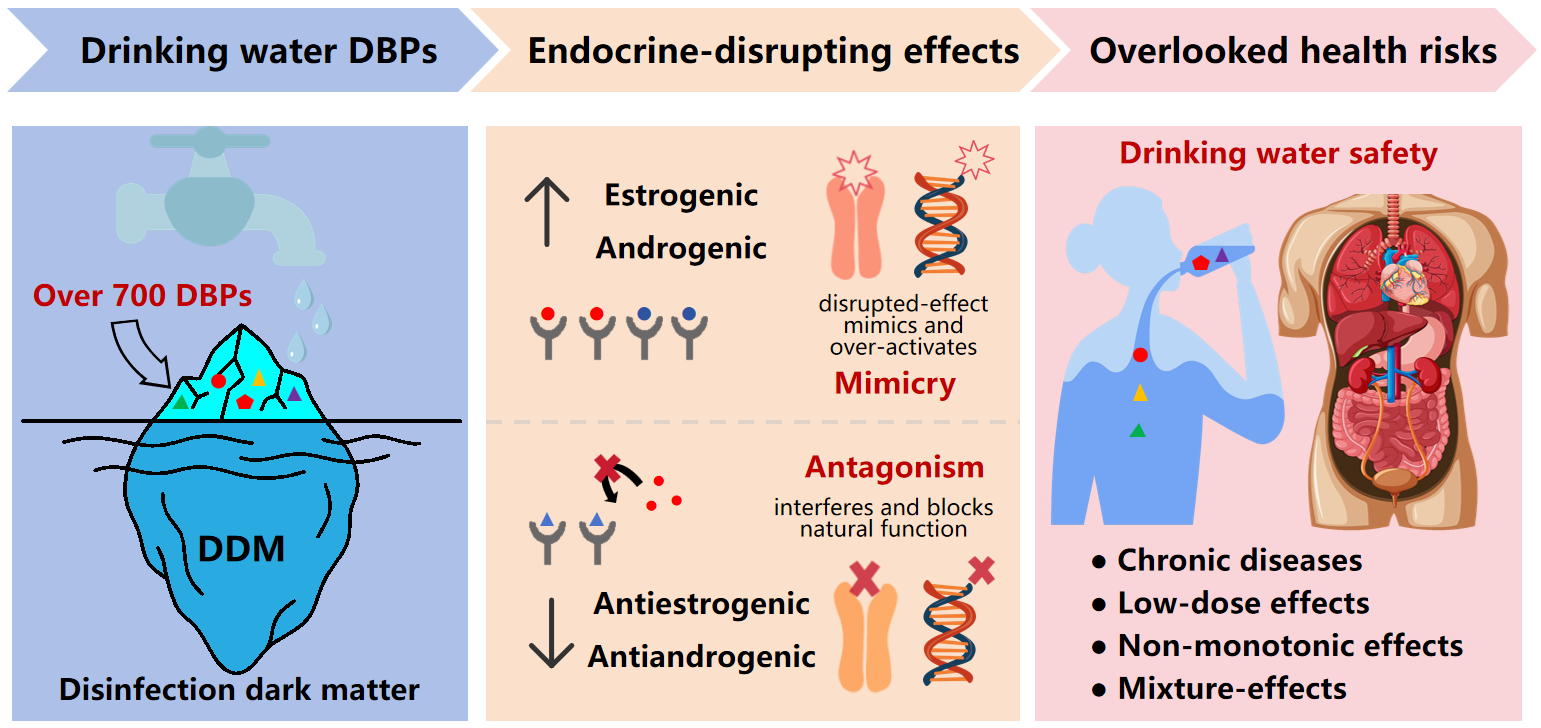
Drinking water safety: the overlooked endocrine-disrupting effects of disinfection byproducts
Disinfection byproducts (DBPs), as ubiquitous chemical contaminants in drinking water, pose a significant threat to public health owing to their documented genotoxicity, carcinogenicity, and reproductive and developmental toxicity. However, the endocrine-disrupting effects of DBPs have long remained overlooked. Recently, accumulating evidence from both experimental and human studies has suggested that certain DBPs can exert estrogenic, androgenic, antiestrogenic, and antiandrogenic activities, implicating that DBPs elicit potential endocrine-disrupting effects. Given that endocrine-disrupting properties represent key biological mechanisms contributing to a broad spectrum of adverse health outcomes, this perspective contends that exposure to drinking water DBPs may underpin overlooked health risks including chronic diseases, highlighting an urgent paradigm shift in how we evaluate drinking water safety. Knowledge gaps and future directions on the endocrine-disrupting effects of DBPs are also proposed.
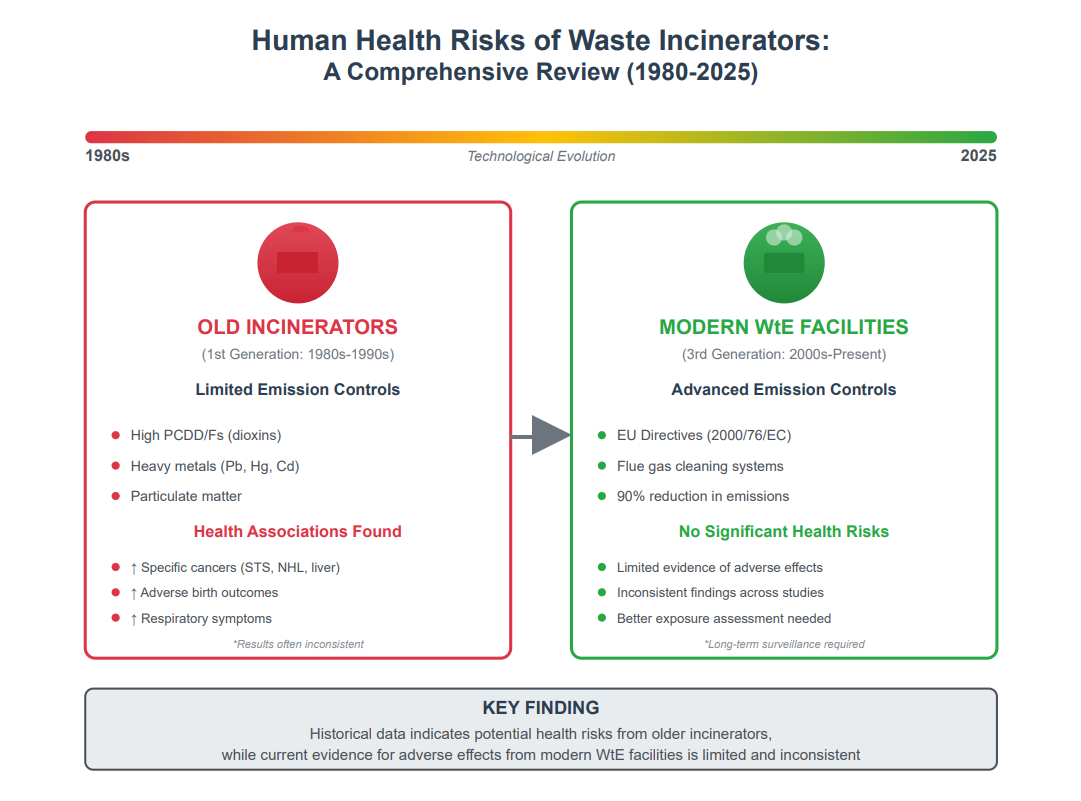
Human health risks of waste incinerators: a narrative review of studies on municipal, hazardous and medical waste incineration
This narrative review synthesizes evidence on human health risks linked to emissions from municipal, hazardous and medical waste incinerators up to August 2025. For the search of information, the databases PubMed, Scopus, Web of Science, and Google Scholar were used. The analysis reveals meaningful differences in health outcomes depending on the age and emission control technology of facilities. Evidence from older, high-emission incinerators indicates elevated cancer risks, particularly for soft tissue sarcoma, non-Hodgkin’s lymphoma, and respiratory cancers in exposed communities. The evidence for adverse reproductive outcomes, including birth defects and adverse birth outcomes, is limited and inconsistent. Respiratory disease and symptoms have been reported in some populations living near older incinerators. Workers at incineration facilities show consistent evidence of elevated exposure to carcinogenic compounds. In contrast, studies on modern waste-to-energy plants with advanced emission controls show substantially diminished or limited health risks. However, the evidence base for newer facilities remains relatively small, and long-term health effects are not yet fully established. Major methodological limitations include crude exposure assessment (reliance on residential proximity), inadequate control for confounding factors, ecological study designs, and heterogeneity in study methods. This review highlights the critical importance of technological advancement in reducing health risks, while underscoring the need for continued surveillance, especially in regions with aging infrastructure or inadequate regulatory oversight.
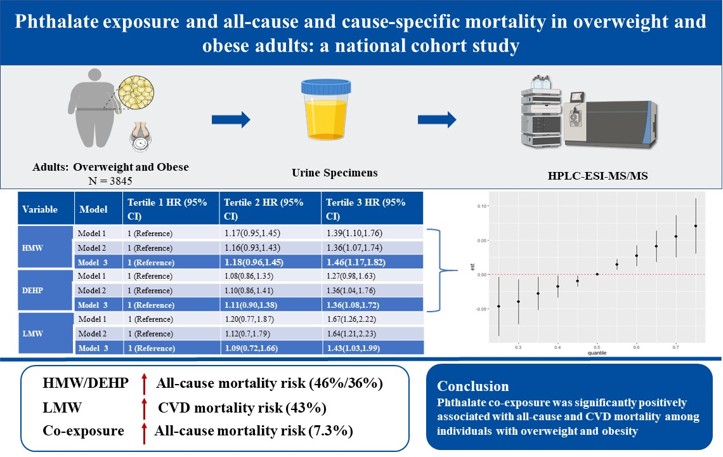
Phthalate exposure and all-cause and cause-specific mortality in overweight and obese adults: a national cohort study
Importance: Phthalate exposure has been found to be associated with an increased risk of obesity. It remains unknown whether exposure to phthalates further impact the health of individuals who are already obese. Objective: To examine the risk of mortality associated with phthalate exposure among individuals with overweight and obesity. Design: A nationally representative sample of adults aged 40 years or older who participated in the US National Health and Nutrition Examination Survey 2001–2010 and provided urine samples for phthalate metabolite measurements. These participants were linked to mortality data from the survey date through December 31, 2019. Exposures: Phthalate metabolites in urine samples were measured by high-performance liquid chromatography-electrospray ionization-tandem mass spectrometry. Main Outcome Measures: Mortality from all causes, cardiovascular disease (CVD), and cancer. Results: This cohort study included 3,845 adults aged 40 years or older (mean age 56.5 [0.3] years). During 46,261 person-years of follow-up (median 12 years; maximum 19 years), 990 deaths occurred, of which 304 were from CVD and 246 were from cancer. Elevated concentrations of high-molecular-weight (HMW) urinary phthalate metabolites and di-2-ethylhexylphthalate (DEHP) were associated with a 46% and 36% increased risk of all-cause mortality, respectively. Regarding low-molecular-weight (LMW) phthalates, higher exposure was specifically linked to a 43% excess risk of CVD mortality. Bayesian kernel machine regression (BKMR) analyses indicated a 7.3% increase in all-cause mortality associated with phthalate co-exposure (75th vs. 50th percentile). Conclusions and Relevance: In this nationally representative study, phthalate co-exposure was significantly positively associated with all-cause and CVD mortality among individuals with overweight and obesity. Higher levels of HMW and DEHP exposure were linked to increased all-cause mortality, while high LMW exposure was associated with elevated CVD mortality. Further studies are necessary to confirm these findings and investigate the underlying mechanisms.
Trifluoroacetic acid: a pressing need for human biomonitoring, chronic toxicity assessment, and epidemiological research
On May 26, 2025, the German Federal Office for Chemicals (BfC) officially classified trifluoroacetic acid (TFA) as a substance with reproductive toxicity and very persistent and very mobile (vPvM) properties, and submitted the corresponding classification proposal to the European Chemicals Agency (ECHA). Drawing on current evidence, this commentary examines the primary anthropogenic sources of TFA, synthesizes toxicological findings from mammalian studies, and reports the current state of human exposure. Currently, driven by continuous emissions from various anthropogenic sources, environmental concentrations of TFA have been steadily increasing. This widespread environmental exposure has directly led to the prevalent detection of TFA in human. Although the acute toxicity of TFA is relatively low, its ability to accumulate in human body fluids and its potential to bind to proteins collectively constitute long-term health risks that cannot be overlooked. However, data on the toxicological mechanisms of long-term TFA exposure, and epidemiological evidence remain very limited. In this context, we call for stricter regulation of such highly persistent substances while prioritizing research on human biomonitoring, chronic toxicity assessment, and epidemiological research of TFA and other short-chain PFAS, thereby providing scientific support for developing effective environmental control strategies.
