
Neuroelectronics
ISSN: 3006-1032 (Print)
ISSN: 3006-1040 (Online)
CODEN: NEURV5
Lossy compression with feature reduction preserves motor decoding for brain-computer interfaces
Implantable neural prosthetic systems must transmit multichannel peripheral nerve recordings under strict power and wireless bandwidth constraints. This study evaluates a compression based feature reduction (CBFR) pipeline that couples transform domain lossy compression with post-compression feature reduction to preserve motor decoding while reducing data rate. After preprocessing, signals are compressed using Sym4/Haar the discrete wavelet transform (DWT), the discrete cosine transform (DCT), or the Walsh–Hadamard transform (WHT) with coefficient soft-thresholding, reconstructed, and used to compute 14 time-domain features. CBFR then computes feature-wise normalized root mean square error (NRMSE) relative to the preprocessed baseline and discards features that are insufficiently preserved before training a GRU classifier. On invasive recordings, CBFR achieves up to 11.29× compression while keeping accuracy about 11% above baseline. On non-invasive recordings, compression ratios up to 21.08× are obtained while accuracy remains about 5% above baseline. DCT provides consistently strong balanced accuracy and compression results, whereas WHT produces higher compression with greater variability. All evaluations are performed in software on recorded datasets, and end-to-end on-device benchmarking and direct comparisons to learned compressors remain future work.

Latest advances in neurointerface-based electrical stimulation for spinal cord injury: a review
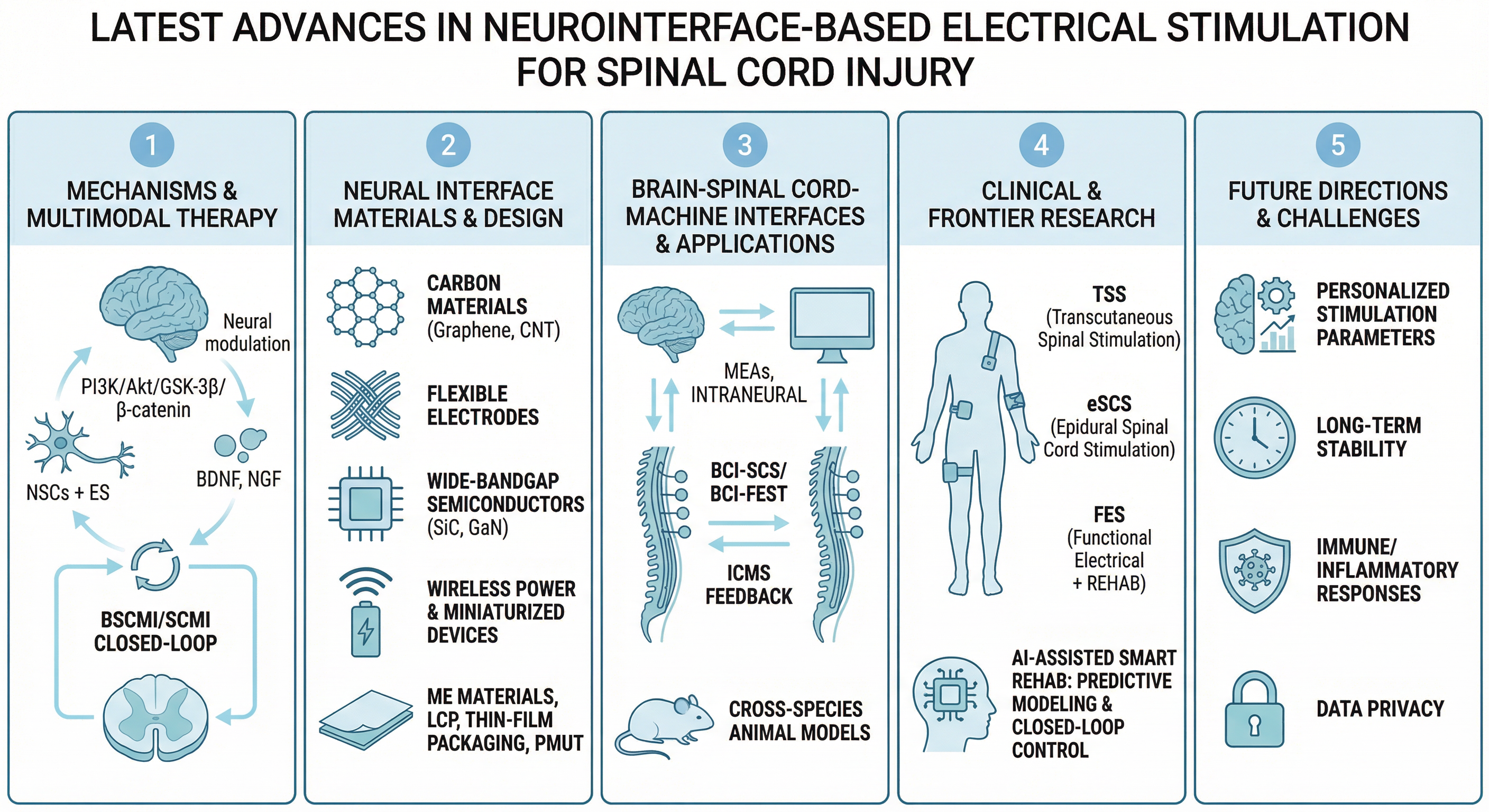
Spinal cord injury (SCI) causes severe damage to neural pathways, leading to substantial motor and sensory deficits that drastically reduce patients’ quality of life. In recent years, electrical stimulation technologies rooted in neurointerface research have gained attention as innovative approaches to encourage neural repair and functional recovery after SCI. This article offers a detailed examination of the most recent advancements in electrical stimulation for SCI, focusing on three key areas: multimodal neuromodulation methods, novel neurointerface materials and designs, and the development of wireless and miniaturized neural stimulation devices. A special focus is placed on brain-spinal cord-machine interface (BSCMI) systems, which aim to re-establish communication between the brain and spinal circuits. The review also examines the underlying mechanisms through which electrical stimulation promotes neural plasticity and aids in functional restoration. Notably, it highlights the growing integration of electrical stimulation with other therapies, including neural stem cell transplantation, intelligent rehabilitation techniques, and AI-driven personalized treatment plans. Despite these promising developments, several technical hurdles remain. The article concludes by discussing these challenges and outlining future research directions, with the goal of offering valuable insights for clinical practice and improving outcomes for individuals with SCI. Ultimately, this analysis emphasizes the significant potential of neurointerface-based electrical stimulation in transforming SCI treatment and enhancing patient recovery.
A review of wireless power and data transfer systems for biomedical implants
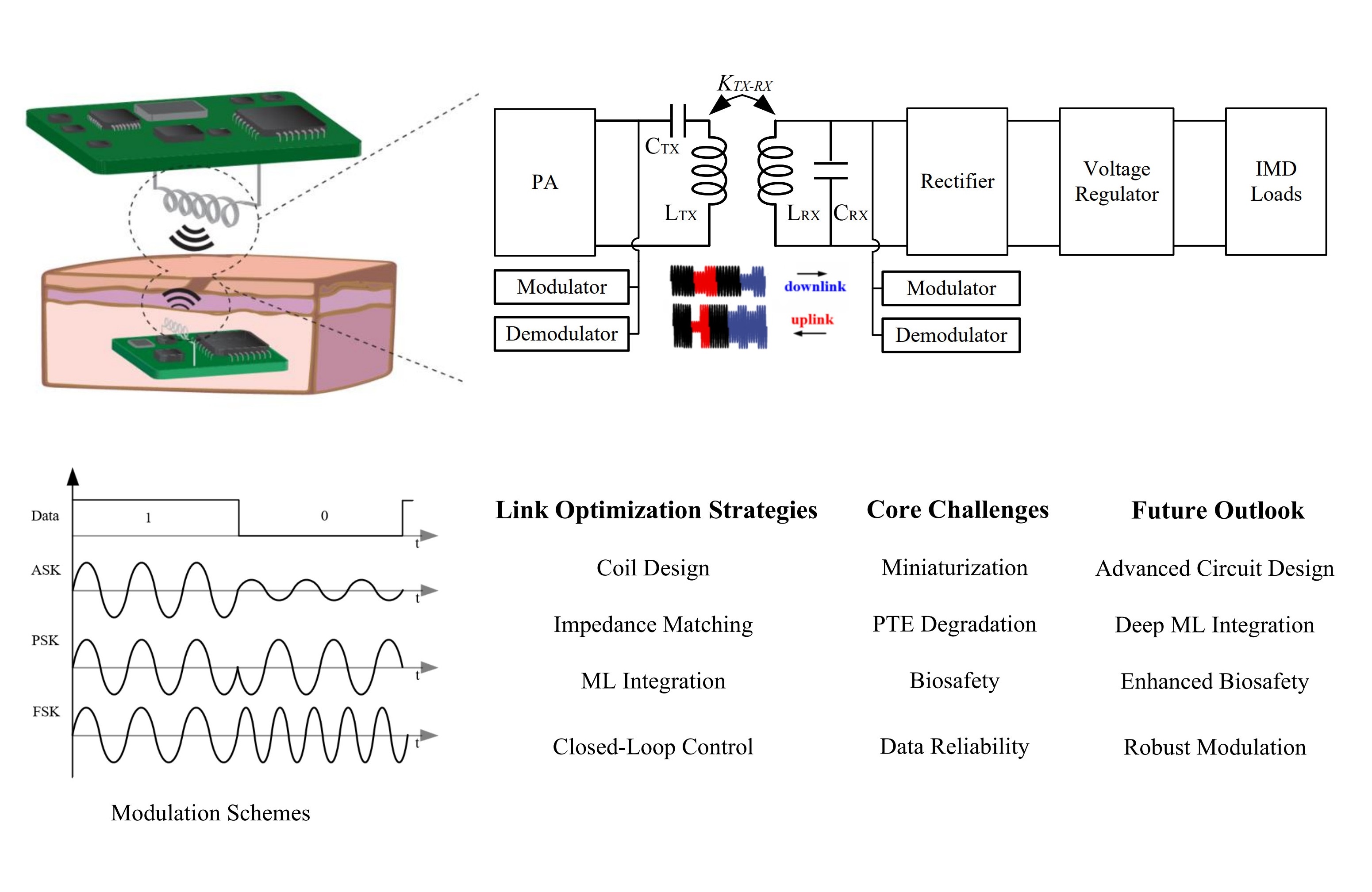
This paper reviews recent research on wireless power and data transfer (WPDT) systems for implanted medical devices (IMDs). Focusing primarily on inductive WPDT systems, the review incorporates theoretical analyses and discussion of link optimization strategies. These strategies target power transfer efficiency (PTE) degradation caused by impedance mismatch, coil misalignment, inter-coil distance, and coupling angle-induced magnetic field inhomogeneity, summarizing referable solutions to mitigate such performance losses. The review also details key WPDT system components: in the power path, it covers power amplifiers, rectifiers, and voltage regulators; in the data path, it involves modulation schemes such as Amplitude-Shift Keying (ASK), Phase-Shift Keying (PSK), Frequency-Shift Keying (FSK), and Load-Shift Keying (LSK). Addressing the core challenge of balancing high PTE (typ. 50%) and data rate (typ. 0.1–2Mbps) under dynamic coupling and load variations, it summarizes the circuit innovation directions of each component, extending to integrated innovation paths at the system level. Finally, future directions are outlined, focusing on miniaturization, efficiency optimization via advanced circuits, biosafety, and robust modulation to enhance data reliability and speed, as well as the deep integration of machine learning for performance improvement.