Advanced Manufacturing
ISSN: 2959-3263 (Print)
ISSN: 2959-3271 (Online)
CODEN: AMDAE3
CiteScore 2025: 1.1
Rotary ultrasonic machining of single-crystal silicon
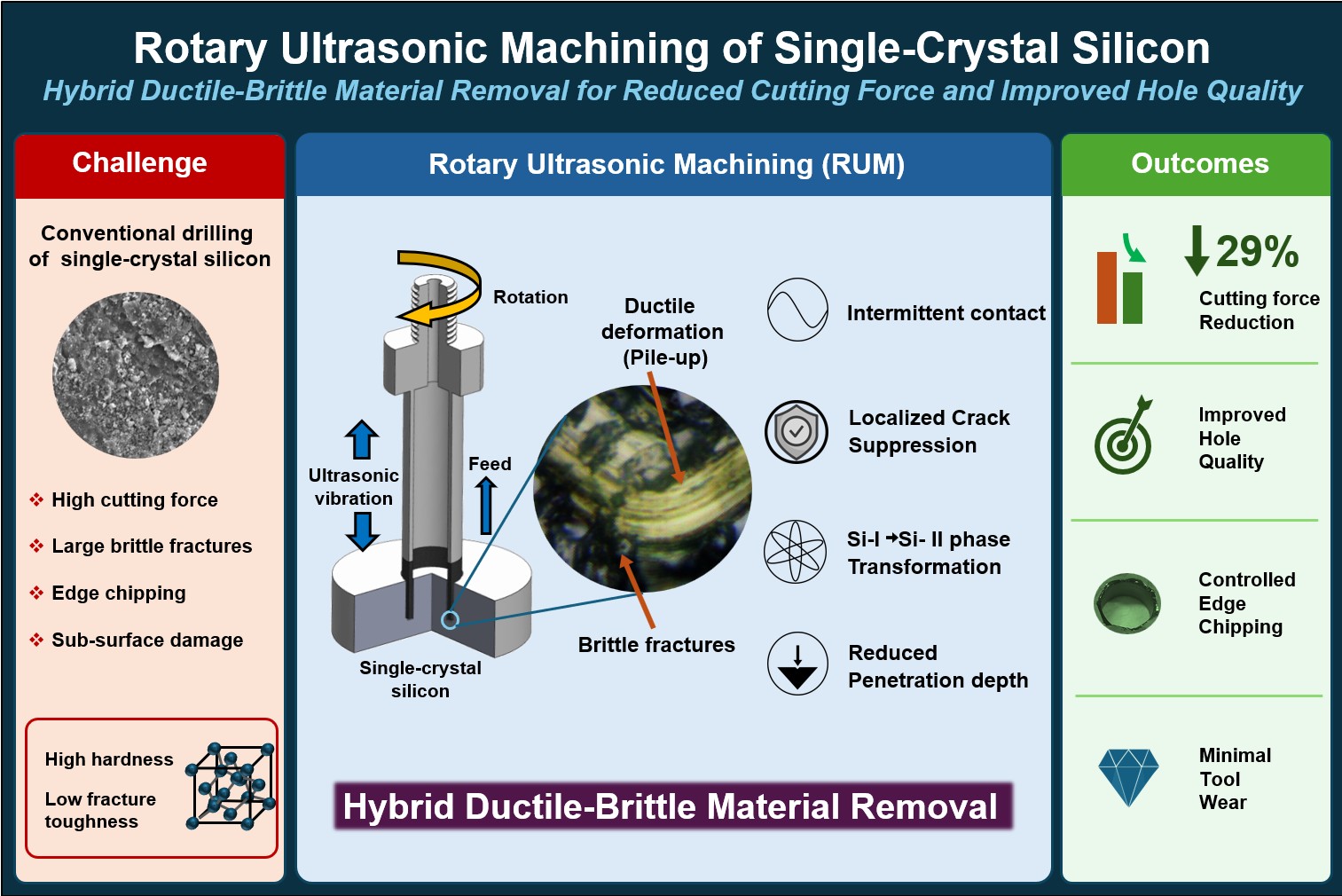
Precision machining of single-crystal silicon components presents critical challenges for the semiconductor and photovoltaic industries due to its high hardness and low fracture toughness. Conventional machining processes are often susceptible to workpiece breakage and subsurface damage, along with high tool wear and poor surface finish. Recent studies have increasingly focused on achieving ductile mode machining of single-crystal silicon using nontraditional machining processes; yet studies on the material removal mechanism remain limited. In this study, the feasibility of rotary ultrasonic machining (RUM) of single-crystal silicon and the material removal mechanism were investigated. The material removal mechanism study via microscopic imaging, motion simulation, and nanoindentation experiments revealed that RUM promoted localized ductile deformation during silicon machining, resulting in a hybrid ductile-brittle material removal mode. The effects of input variables (feedrate, spindle speed, and ultrasonic power) on cutting force, surface roughness, geometrical accuracy of the machined holes, and edge chipping sizes were also evaluated. The results showed that ultrasonic vibration assistance effectively reduced cutting force, while hole quality improvement and edge chipping mitigation were achieved through appropriate selection of machining parameters. Compared with conventional machining conditions, tool wear was also minimal during RUM.
Fabrication of a fused filament extrusion system for recycled PET and comparative mechanical characterization studies vis-à-vis PLA
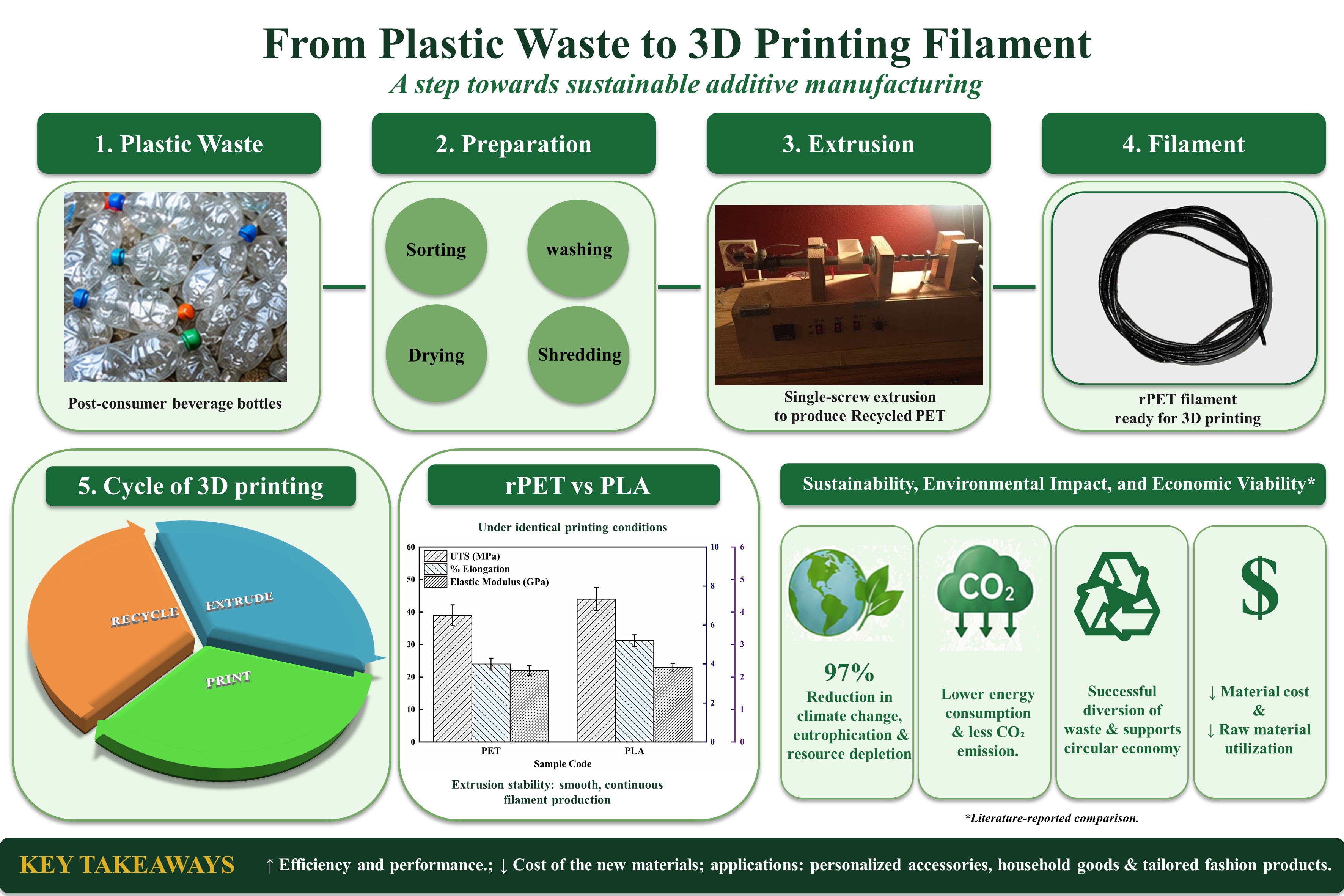
Fused Deposition Modelling (FDM) is a popular additive manufacturing (AM) technique that converts three-dimensional computer-aided design (CAD) models into complex-shaped objects using thermoplastic filaments as a raw material. Existing recyclable plastics, such as Acrylonitrile Butadiene Styrene (ABS), Polyetherimide (PEI), Polyether ether ketone (PEEK), Polylactic Acid (PLA), Polyethylene Terephthalate (PET), and Nylon, can be used to fabricate AM components as alternative for commercially available filaments, as they are a significant source of waste and widely available. This study presents a method of converting waste polymers into filaments for 3D printing. A dual-material extrusion system capable of processing both recycled PET and PLA under identical conditions was developed using a band heater, Proportional-Integral-Derivative (PID) temperature controller, motor, extruder screw and hopper, etc. The experiments were performed to produce the 3D filaments using recycled plastics (in the form of PET) and PLA pellets, and the results were compared. For recycled PET, waste plastics were collected, shredded, and passed through the hopper. The material was melted in the heating chamber at a temperature range of 150–220 °C for PET and 180–210 °C for PLA. The auger bit’s rotatory action delivered the molten material to the nozzle, where the final filament was extruded. The tensile strength of PLA specimens (44 ± 3.6 MPa) was found ~11% higher than PET (39 ± 3.2 MPa). Whereas, the percentage elongation of PET and PLA specimens were found as 4 and 5.2% respectively. This performance affirms that recycled PET, when appropriately processed, can bridge the gap between environmental responsibility and mechanical functionalit y in 3D printing applications. This model will likely help industries improve their efficiency and performance by lowering the cost of the new materials and making it more efficient for them. The produced filament can create personalized accessories, household goods, and distinctive, tailored fashion products.
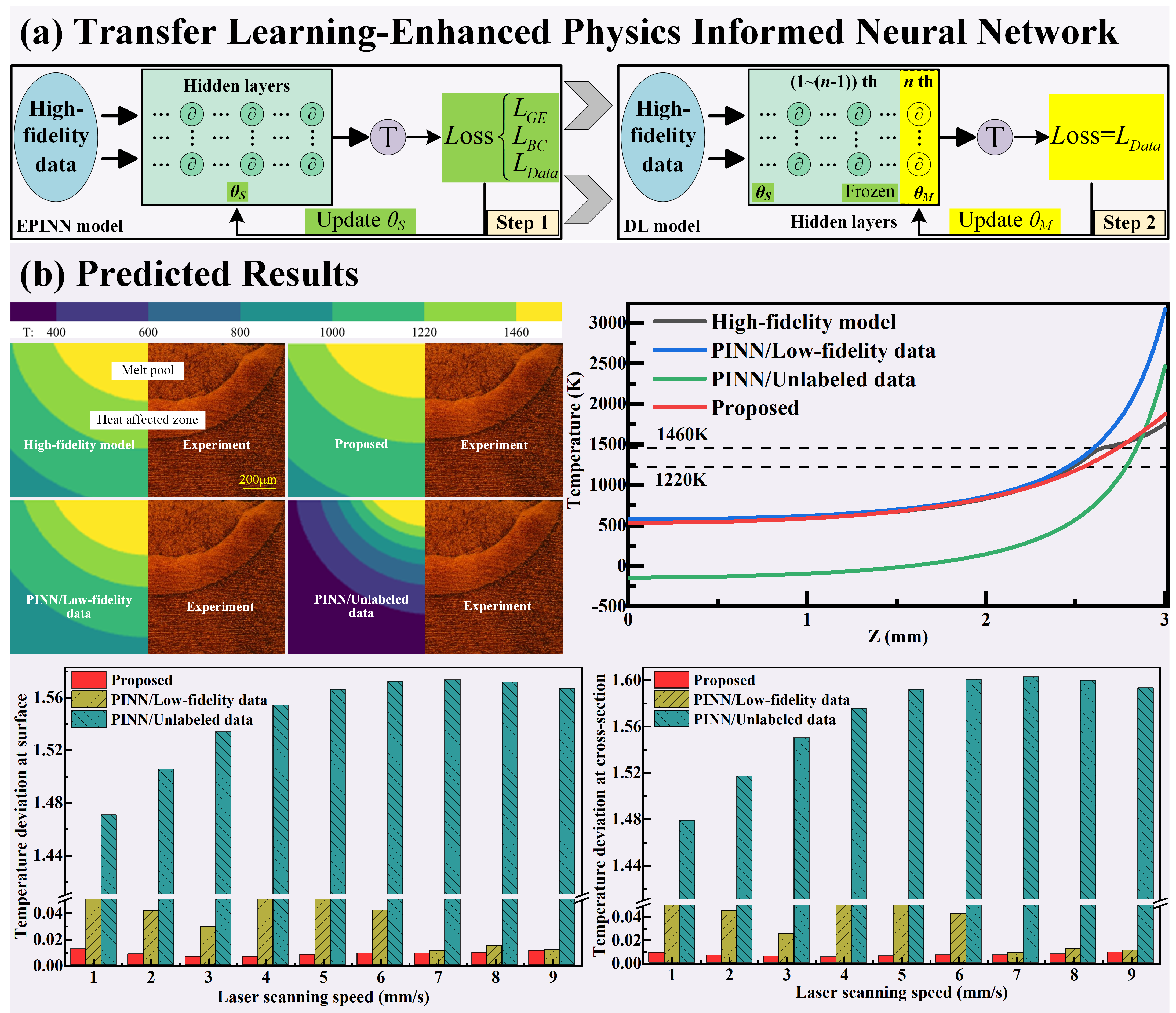
Symmetry-imbued Hamiltonian neural operator architecture for stress field prediction of porous metamaterials
Predicting stress fIelds of porous metamaterials under arbitrary rotations is essential for reliable online monitoring in additive manufacturing. However, existing neural operators are limited by two major issues: geometric orientation bias where identical lattices are misinterpreted under rotation, and non-physical stress leakage caused by the failure of Partial Differential Equation (PDE) constraints at discontinuous void-solid interfaces in porous metamaterials. To address these challenges, we propose the Symmetry-Imbued Hamiltonian Neural Operator (SIHNO) that embeds geometric symmetry and an energy-structured inductive bias into a unified neural operator architecture. Specifically, SIHNO introduces a Rotation-Steerable Lattice Projector (RSLP) that lifts lattice images into a continuous-angle geometric symmetry representation. This geometric representation is further coupled with a Hamiltonian-Fueled Propagator (HFP) that replaces local PDE constraints with Hamiltonian-inspired energy propagation. Finally, a slice-aware convolutional decoder reconstructs stress fields based on RSLP and HFP. Comprehensive experiments demonstrate that SIHNO outperforms existing neural operators. The proposed framework provides a robust architecture for stress-field prediction in additive manufacturing.