Robot Learning
ISSN: 2960-1436 (Print)
ISSN: 2960-1444 (Online)
CODEN: RLABAV
Autonomous collision avoidance for complex multi-ship encounters based on improved dynamic window approach
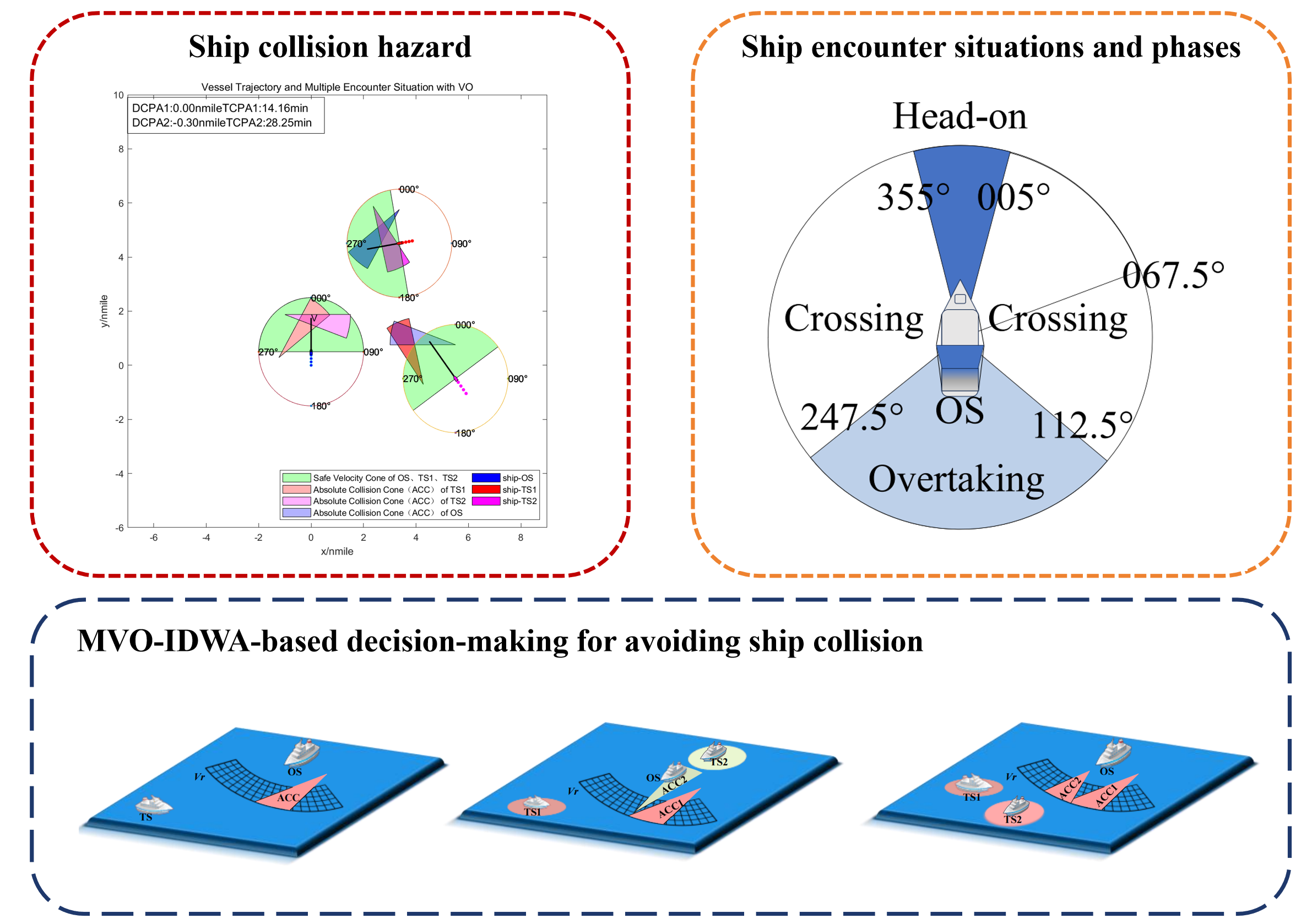
Achieving autonomous navigation requires Maritime Autonomous Surface Ships (MASS) to overcome difficulties in recognizing intricate multi-ship encounter situations and developing appropriate collision avoidance strategies. To address the above issues, this study first integrates the Velocity Obstacle (VO) with Closest Point of Approach/Time to Closest Point of Approach (CPA/TCPA) into the collision risk identification of ships. This enables the own ship (OS) to determine the risk posed by target ships (TSs) in the scenario. Secondly, the paper further discusses complex multi-ship encounter scenarios, based on 1972 International Regulations for Preventing Collision at Sea (COLREGs), it classifies responsibilities to determine the set of give-way ship and stand-on ship obligations. Finally, the derived responsibility set is incorporated into Dynamic Window Approach (DWA), allowing the enhanced Multi-Vessels Velocity Obstacle and Improved Dynamic Window Approach (MVO-IDWA) algorithm to automatically select optimal decisions in complex multi-ship encounter scenarios and ensure the ship reaches its destination safely. Centering on the challenge of avoiding collision decision in multi-ship complex encounter scenarios, this paper proposes the integration of ship responsibility sets with the MVO-IDWA algorithm. Analysis of the results establishes that the proposed algorithm can consider the inter-ship responsibilities, risk levels, and movement trends of TSs in multi-ship encounters, thereby realizing autonomous ship collision avoidance.
Deep learning for underwater object detection: a comprehensive survey of models, datasets, and challenges
This survey provides a comprehensive synthesis of methods, datasets, metrics, and deployment strategies from the evolution of convolutional neural network (CNN)-based detectors to emerging transformer and hybrid architectures. It unifies fragmented literature into a structured taxonomy while integrating results from 2014–2025 studies. The paper reviews benchmark datasets, discusses evaluation protocols and reproducibility standards, and proposes a deployment playbook considering latency, energy, and hardware constraints. Beyond technical performance, it addresses responsible AI practices and ethical challenges in marine observation. By highlighting open problems in multimodal fusion, self-supervised learning, and on-device adaptation, this work aims to guide future research and practical deployment of underwater vision systems. A comprehensive survey of underwater object detection covering classic CNN-based detectors, modern transformer and hybrid models, training and evaluation practices under challenging aquatic conditions, the dataset landscape, deployment constraints (latency/VRAM/energy), and open problems for real-world marine applications.

FotoBot: an embodied AI photography robot system its design, prototyping and application
This paper introduces FotoBot, a vision-driven autonomous robot photographer designed to enhance human–robot interaction (HRI) and optimize camera parameter control through real-time visual perception. FotoBot integrates Generative Pre-trained Transformers (GPT) for seamless natural language communication, and Bipedal Toric Space (BTS) for vision-guided camera viewpoint control. Utilizing GPT, FotoBot effectively interprets and responds to user instructions, enabling intelligent behavior adjustments. BTS is introduced in this paper for camera position planning, which compresses the camera position representation into three parameters related to photo composition. The BTS representation is analytically converted into Cartesian navigation goals for robot execution. The adoption of BTS ensures the robot’s feasibility around targets and adherence to cinematographic standards. Deployed on a biped robot platform, FotoBot demonstrates comprehensive navigation capabilities, effective human-robot interaction, and outstanding auto-photography performance. User trials conducted at the Hong Kong Science Park have validated FotoBot’s proficiency in navigating complex terrains and capturing high-quality photographs while intelligently responding to user instructions. Videos and code are available on the project website: https://sites.google.com/view/fotobot/fotobot.