Advanced Manufacturing

ISSN: 2959-3263 (Print)

ISSN: 2959-3271 (Online)

CODEN: AMDAE3

CiteScore 2025: 1.1

About This Journal
Special Issues
View more
Advanced Manufacturing of Materials
Special Issue Editor:   Prashanth Konda Gokuldoss, Sokkalingam Rathinavelu
Submission Deadline:  31 December 2026
AI and Data-driven Manufacturing
Special Issue Editor:   Vishal Santosh Sharma, Noe G. Alba Baena, Rajeev Verma, Liang Hao
Submission Deadline:  31 March 2027
Adaptive Scheduling in IoT-Enabled Smart Manufacturing Networks
Special Issue Editor:   Jianming Zhang, Yu Xue, Sunil Kumar Jha
Submission Deadline:  31 January 2027
Latest Articles
View more
Artificial intelligence in additive and smart manufacturing: a critical review of design, process optimization, and quality control
Rajeev Verma,Shalom Akhai
Review04 Sep 2026OPEN ACCESS

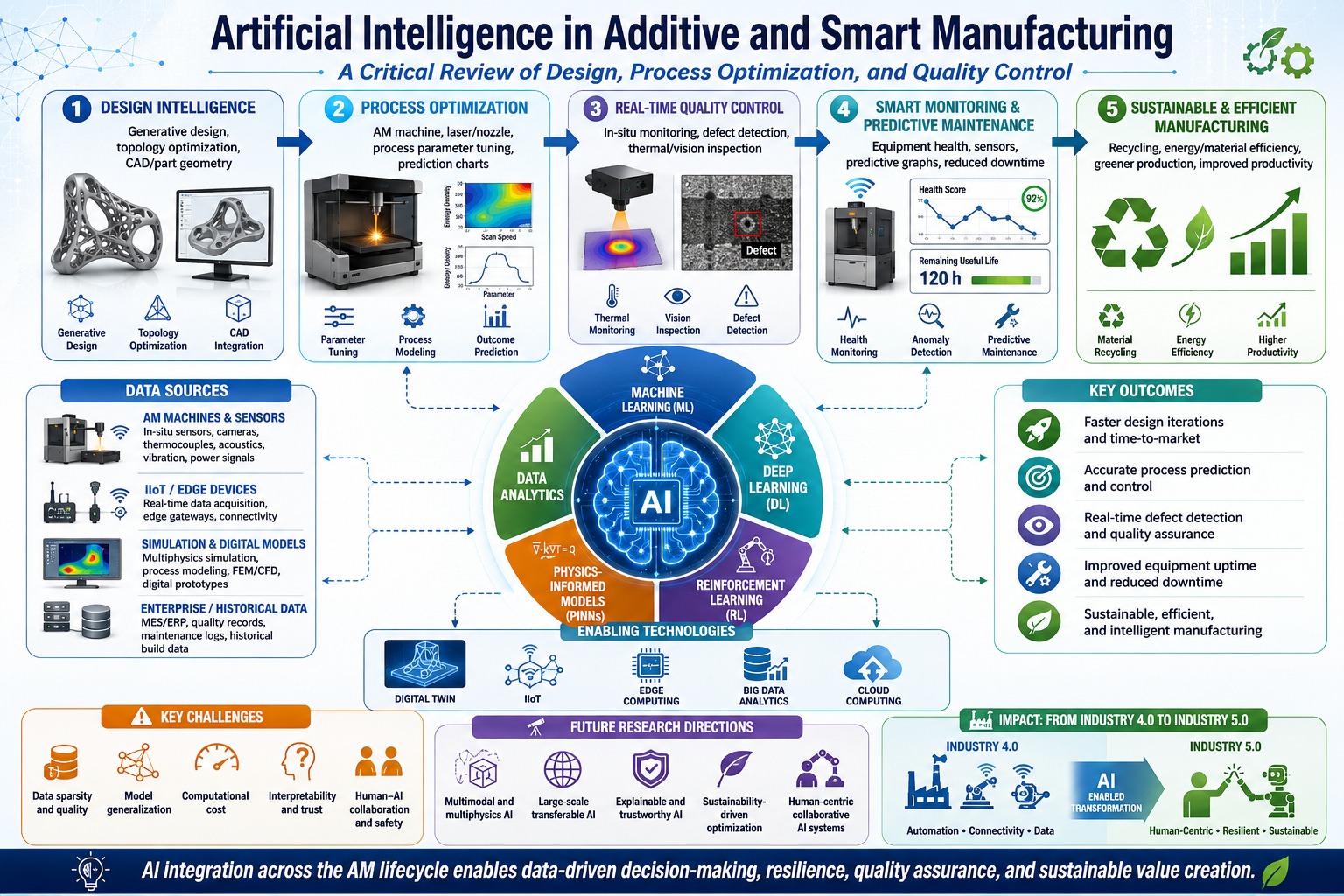
The rapid adoption of artificial intelligence (AI) in the production sector has triggered a revolutionary change in the design, manufacturing, monitoring, and optimization. The paper is a critical analysis of AI-based additive manufacturing (AM) and smart manufacturing systems with an emphasis on design intelligence and process optimization, real-time quality control, and sustainable production. Based on recent literature, this paper considers the major AI methods, such as machine learning (ML), deep learning (DL), reinforcement learning (RL), and physics-informed neural networks (PINNs) throughout the manufacturing lifecycle. The results show that AI can greatly decrease the time spent on design iterations, increase the accuracy of predictions of process parameters, and allow in-situ defect detection with high accuracy. Moreover, AI helps to ensure predictive maintenance strategies, reduce the number of unforeseen failures and enhance operational efficiency. The interplay of AI and digital twin technology, Industrial Internet of Things (IIoT), edge computing, and big data analytics is cited as a pillar of Industry 4.0 and the future Industry 5.0 paradigm. Regardless of these developments, the issues of data sparsity, the applicability of the model, computational expense, and interpretability are the key obstacles to large-scale industrial adoption. The value of human-AI cooperation and the necessity to have explainable and reliable AI systems in critical safety areas are also emphasized in the study. Lastly, the review provides future research directions, which focus on multi-modal AI, large-scale manufacturing models, and sustainability-based optimization frameworks. In general, the article is a thorough synthesis of the recent developments and realistic directions of introducing AI-enabled smart manufacturing.

PDF
Rotary ultrasonic machining of single-crystal silicon
Kh M Asif Raihan,Isaac Obembe,Deven Wieland,Christopher Jones,Meng Zhang
Article27 Aug 2026OPEN ACCESS

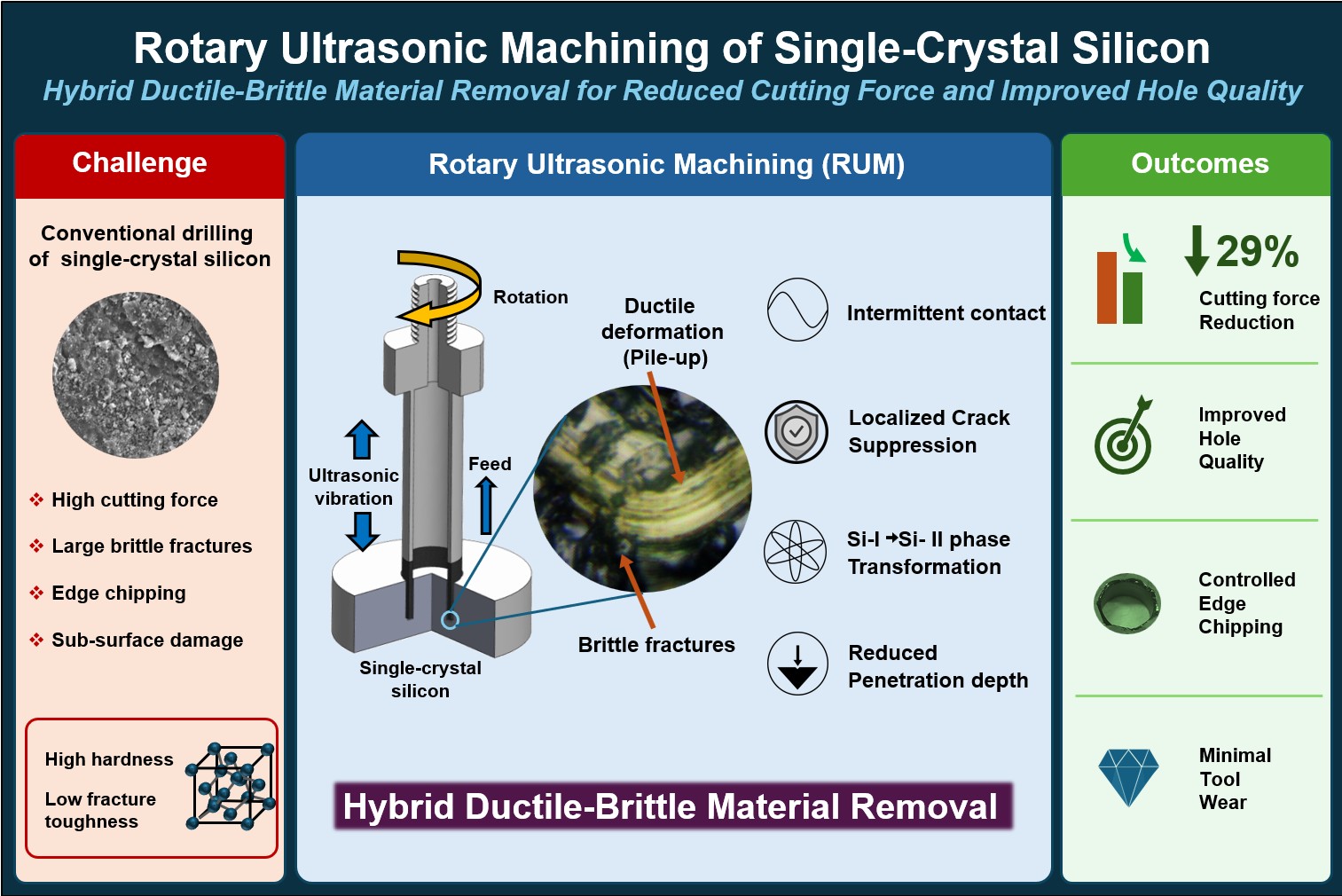
Precision machining of single-crystal silicon components presents critical challenges for the semiconductor and photovoltaic industries due to its high hardness and low fracture toughness. Conventional machining processes are often susceptible to workpiece breakage and subsurface damage, along with high tool wear and poor surface finish. Recent studies have increasingly focused on achieving ductile mode machining of single-crystal silicon using nontraditional machining processes; yet studies on the material removal mechanism remain limited. In this study, the feasibility of rotary ultrasonic machining (RUM) of single-crystal silicon and the material removal mechanism were investigated. The material removal mechanism study via microscopic imaging, motion simulation, and nanoindentation experiments revealed that RUM promoted localized ductile deformation during silicon machining, resulting in a hybrid ductile-brittle material removal mode. The effects of input variables (feedrate, spindle speed, and ultrasonic power) on cutting force, surface roughness, geometrical accuracy of the machined holes, and edge chipping sizes were also evaluated. The results showed that ultrasonic vibration assistance effectively reduced cutting force, while hole quality improvement and edge chipping mitigation were achieved through appropriate selection of machining parameters. Compared with conventional machining conditions, tool wear was also minimal during RUM.
PDF
Fabrication of a fused filament extrusion system for recycled PET and comparative mechanical characterization studies vis-à-vis PLA
Amit Kumar Singh Chauhan,Utkarsh Mishra,Aryan Vinod Shukla,Mukul Shukla
Article19 Aug 2026OPEN ACCESS

Fused Deposition Modelling (FDM) is a popular additive manufacturing (AM) technique that converts three-dimensional computer-aided design (CAD) models into complex-shaped objects using thermoplastic filaments as a raw material. Existing recyclable plastics, such as Acrylonitrile Butadiene Styrene (ABS), Polyetherimide (PEI), Polyether ether ketone (PEEK), Polylactic Acid (PLA), Polyethylene Terephthalate (PET), and Nylon, can be used to fabricate AM components as alternative for commercially available filaments, as they are a significant source of waste and widely available. This study presents a method of converting waste polymers into filaments for 3D printing. A dual-material extrusion system capable of processing both recycled PET and PLA under identical conditions was developed using a band heater, Proportional-Integral-Derivative (PID) temperature controller, motor, extruder screw and hopper, etc. The experiments were performed to produce the 3D filaments using recycled plastics (in the form of PET) and PLA pellets, and the results were compared. For recycled PET, waste plastics were collected, shredded, and passed through the hopper. The material was melted in the heating chamber at a temperature range of 150–220 °C for PET and 180–210 °C for PLA. The auger bit’s rotatory action delivered the molten material to the nozzle, where the final filament was extruded. The tensile strength of PLA specimens (44 ± 3.6 MPa) was found ~11% higher than PET (39 ± 3.2 MPa). Whereas, the percentage elongation of PET and PLA specimens were found as 4 and 5.2% respectively. This performance affirms that recycled PET, when appropriately processed, can bridge the gap between environmental responsibility and mechanical functionalit y in 3D printing applications. This model will likely help industries improve their efficiency and performance by lowering the cost of the new materials and making it more efficient for them. The produced filament can create personalized accessories, household goods, and distinctive, tailored fashion products.

PDF
Top Downloaded
View more
A review on physics-informed machine learning for monitoring metal additive manufacturing process
Shoulan Yang,Shitong Peng,Jianan Guo,Fengtao Wang
Article10 Jun 2024OPEN ACCESS
The traditional data-driven models and pure physics models have been widely employed in quality prediction for additive manufacturing (AM). However, data-driven models rely on a large amount of labeled data, while pure physics models suffer from lower computational efficiency and accuracy. The Physics-Informed Neural Network (PINN) model has emerged as a hybrid data-driven paradigm that imbues data-driven models with physical domain knowledge. To refrain from the inherent “black box” or inefficiency of AM process prediction or monitoring, this paper discusses the pros and cons of traditional data driven methods and pure physics models and further elaborates on the principles and architecture of the PINN model along with its applications in AM research. We review and analyze current state-of-the-art PINN applications to AM, focusing on temperature field prediction, fluid dynamics issues, fatigue life prediction, accelerated finite element simulation, and process characteristics prediction. The corresponding embedded physical knowledge, either integrated into loss function or data preprocessing, is also summarized for these applications. Based on this review, we identify the challenges of PINN and provide an outlook for further research of its AM applications.
Full Text PDF References
Transfer learning-enhanced physics informed neural network for accurate melt pool prediction in laser melting
Qingyun Zhu,Zhengxin Lu,Yaowu Hu
Article03 Jan 2025OPEN ACCESS
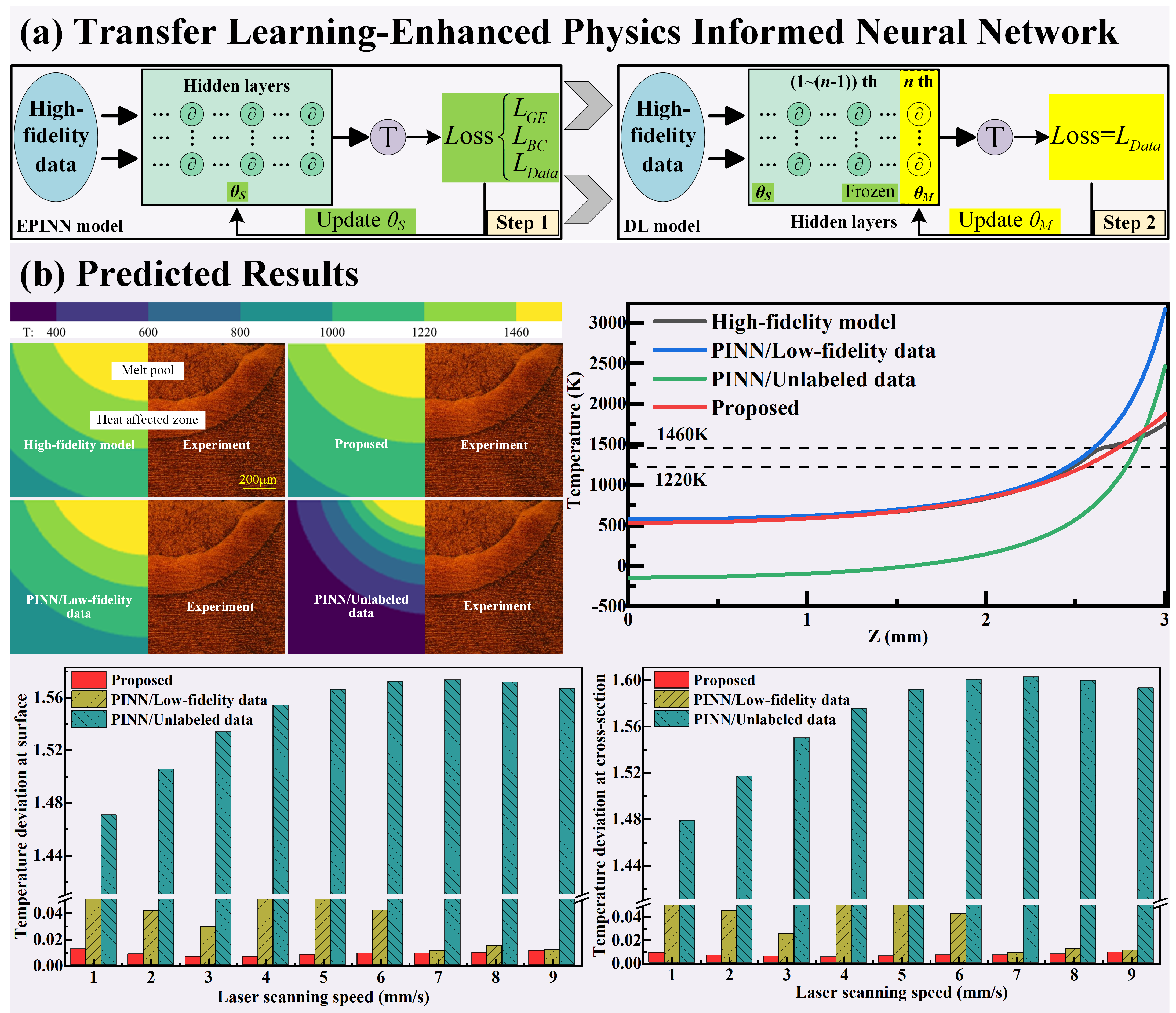
The profile of the melt pool is essential in selective laser melting (SLM) to control the process quality and avoid defects. Physics informed neural network (PINN) method is proposed to address challenges in various science and engineering problems when traditional numerical calculations are time-consuming, or deep learning (DL) methods have high demand for data. However, SLM process involves many complex physical phenomena. Low-fidelity data from low-fidelity models struggle to accurately reflect these phenomena, while high-fidelity data from high-fidelity models contains more physical equations, making it difficult for current PINN. This article proposed a transfer learning-enhanced PINN (TLE-PINN) method using high-fidelity data for precise and fast melt pool prediction. It contains the enhanced PINN (EPINN) and transfer learning framework. The EPINN model integrates the heat transfer law and boundary condition to loss function, imposing strong physical constraints on data. Then, the transfer learning framework, combining the concepts of PINN and DL, initially trains with PINN and then further fine-tunes it using DL method. Notably, it only uses a single model, which is more convenient to traditional methods that require two models. The developed solution demonstrates outstanding performance when compared with experiments and existing methods, showing significant potential for industrial applications.
PDF
Creating custom 3D printing material colors using optical modeling of waste plastic
Kimia Aghamohammadesmaeilketabforoosh,Joshua Givans,Morgan Woods,Joshua Pearce
Article07 Apr 2025OPEN ACCESS
Distributed recycling and additive manufacturing (DRAM) offer a unique promise for obtaining a circular economy. To maintain or even enhance the value of common 3D printing feedstocks like polylactic acid (PLA) waste an approach to further incentivize prosumers to use recycled feedstocks is to provide something the market currently does not—custom filament colors. To enable prosumers to create custom colors from their own recycled 3D printing waste this article presents a new open-source software named SpecOptiBlend. Specifically, this study introduces a novel method for customizing color filaments by recycling waste 3D printing samples, thereby enhancing the capabilities of color 3D printing. Traditional 3D printing is limited by a narrow range of filament colors, and even multi-color printing heads can utilize only a limited number of colored filaments among the available options. The new approach here repurposes discarded prototypes and unused samples back into the printing cycle with desired colors, allowing for a broader spectrum of colors and gradients. This enables engineers and designers to create more intricate and functionally graded materials. To do this, waste plastics are quantified after processing for spectral reflectance, then Kubelka-Munk theory provides the initial estimate for color mixing. Three discrete optimization techniques are applied: Nelder-Mead, Limited-memory BFGS with bounds, and Sequential Least Squares Quadratic Programming. To determine the optimal method, assessment criteria include the application of root mean square (RMS) and the color difference (ΔE CIE-2000). Three case studies were conducted, and the Nelder-Mead method was found to provide an optimal balance between the precision of color differences and the RMS, essential for producing high-quality colors. This research has provided a free tool that will now enable prosumers to convert their plastic waste into specific custom colors to enable DRAM.
PDF